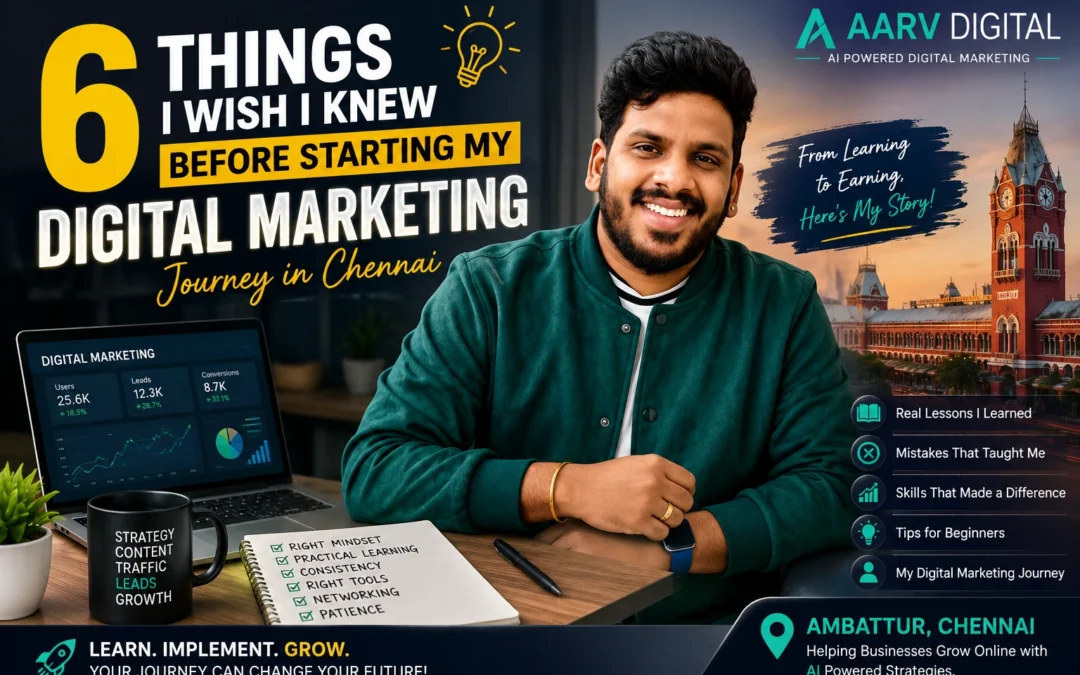
Discover the 6 things I wish I knew before starting a digital marketing course in Chennai and how they changed my learning experience.
Introduction
This Article is written by Arvind Founder of Aarv Digital I bring extensive experience in digital marketing, business growth, and online branding. Through this article, I share practical insights and industry knowledge to help readers stay informed and make better strategic decisions. You can follow Aarv Digital on LinkedIn for more of these.
If I could go back to the day before I enrolled in a digital marketing course in Chennai, I’d tell myself one thing:
“You’re about to learn much more than digital marketing.”
Like many beginners, I entered the course with a very basic understanding of what digital marketing actually involved. I thought it was mostly about:
- Social media posts
- Online advertisements
- Writing content
That was pretty much it. But as the weeks progressed, I realized I had underestimated the industry completely.
Digital marketing today is a combination of technology, creativity, strategy, automation, data, and Artificial Intelligence. Looking back, there are several things I wish someone had told me before I started.
Not because the course was difficult. But because I would have approached the entire experience differently.
If you’re considering a digital marketing course in Chennai, these six lessons might help you make the most of your journey from day one.
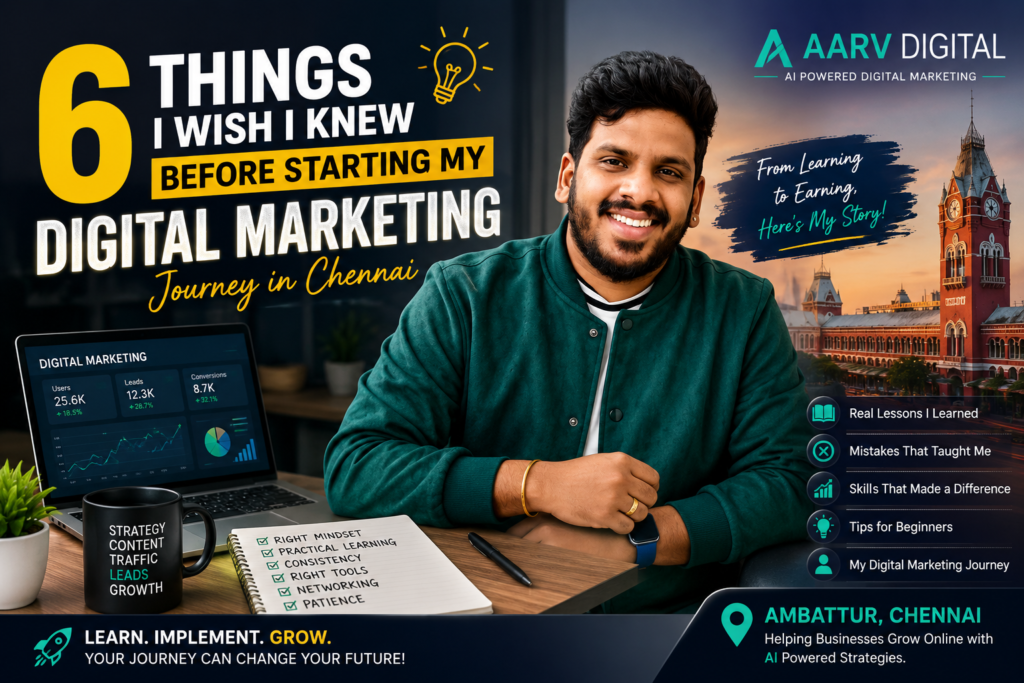
Why Most People Enter a Digital Marketing Course With the Wrong Expectations
Before diving into the six lessons, it’s important to understand a common mistake. Most beginners focus on outcomes. They think about:
- Getting a job
- Earning certifications
- Learning a new skill
- Exploring career opportunities
Those goals are important. But the real value of a digital marketing course often comes from the skills, systems, and practical experiences developed along the way. That’s something I only understood after I started learning.
1. I Wish I Knew That Digital Marketing Is Much Bigger Than Social Media
This was probably my biggest misconception. When I heard “digital marketing,” I immediately thought about Instagram and Facebook. What I discovered was an ecosystem of interconnected skills. The curriculum included areas such as:
Search Engine Optimization
Learning:
- WordPress
- Domain setup
- Hosting setup
- On-page SEO
- Off-page SEO
- Link building
- Local SEO
- Community SEO
- Video SEO
Paid Advertising
Understanding:
- Google Ads
- Meta Ads
- Campaign structures
- Audience targeting
Content Systems
Exploring how content supports business growth. The biggest lesson? Digital marketing is not a single skill. It’s a collection of specialized disciplines working together.
2. I Wish I Knew That AI Would Be Everywhere
If someone had told me before joining that AI would become one of the most valuable parts of my learning experience, I probably wouldn’t have believed them. Today, AI influences nearly every aspect of marketing. The training introduced:
AI Fundamentals
Understanding how AI supports modern marketing workflows.
Prompt Engineering
Learning structured approaches to working with AI tools.
Generative AI
Using AI technologies for:
- Text creation
- Image creation
- Video creation
- Voice generation
One thing became obvious very quickly. AI isn’t replacing marketers. It’s becoming a tool that helps marketers work more efficiently.
3. I Wish I Knew How Important Practical Projects Would Be
Before joining, I assumed most learning would happen during classes. I was partially right. But the biggest growth happened outside the sessions. The course included:
- Weekly assignments
- Practical exercises
- Campaign creation
- Capstone projects
These projects forced me to apply concepts. And application changes everything. Reading about SEO is one thing. Working on SEO-related tasks is something entirely different. The same applies to advertising, content creation, automation, and analytics. Practical learning accelerated my understanding more than anything else.
| What to ask a course | Good answer | Warning sign |
|---|---|---|
| What will I have built by the end? | Named live projects | A list of modules covered. |
| Who teaches the AI modules? | Someone who ships work with them | A generalist reading slides. |
| Can I speak to past students? | Yes, here are two | Hesitation or deflection. |
| What is the placement rate? | An honest, defined number | A large percentage with no definition. |
| How much time outside class? | A realistic figure | Whatever suits you. |
4. I Wish I Knew That Automation Is Becoming a Core Skill
When most people think about digital marketing, automation isn’t the first thing that comes to mind. It certainly wasn’t for me. Then I discovered how important automation has become. The learning covered:
AI Agents
Understanding automated systems and workflows.
Website Chatbots
Exploring how businesses improve customer interactions.
Lead Automation
Learning automated processes that improve efficiency.
Publishing Systems
Understanding structured content workflows. This completely changed how I viewed digital marketing. Modern marketing is no longer just about creating campaigns. It’s also about creating systems.
5. I Wish I Knew That Building a Portfolio Matters More Than Collecting Certificates
Before enrolling, I assumed the certificate would be the most important outcome. After completing the course, my perspective changed. The portfolio became equally valuable. Throughout the program, students build:
- Marketing plans
- Strategic frameworks
- Campaign structures
- Project work
- Automation workflows
Why does this matter? Because practical work demonstrates capability. Anyone can say they understand a topic. A portfolio shows it. Looking back, I wish I had focused on portfolio development from the very first week.
6. I Wish I Knew That Personal Branding Is Part of the Journey
This was probably the most unexpected lesson. I thought digital marketing education would focus exclusively on brands and businesses. Instead, I learned the importance of personal branding. The curriculum included:
LinkedIn Optimization
Learning how to position yourself professionally.
Content Creation
Understanding how visibility creates opportunities.
Professional Presence
Building credibility online. These lessons felt particularly relevant because the digital world increasingly rewards visibility and expertise.
What Surprised Me Most About the Learning Experience
Beyond the six lessons, several things exceeded my expectations.
The Industry Is More Data-Driven Than I Expected
Marketing decisions are increasingly supported by data and performance metrics.
Advertising Is More Strategic Than It Looks
Google Ads and Meta Ads require planning, optimization, and analysis.
AI Is Already Transforming Workflows
What once felt futuristic is now becoming part of everyday marketing.
Continuous Learning Is Essential
Digital marketing evolves constantly. The most successful marketers keep learning.
The Skills That Had the Biggest Impact on Me
If I had to identify the areas that changed my perspective the most, they would be:
- Search Engine Optimization
- Google Ads
- Meta Ads
- Artificial Intelligence
- Prompt Engineering
- Marketing Automation
- AI Agents
- Personal Branding
- Portfolio Building
Each skill added a new layer of understanding. Together, they created a much broader view of what digital marketing actually is.
Why Structured Learning Made a Difference
One of my original assumptions was that free resources could replace structured education. After completing the course, I view that differently. The value wasn’t simply access to information. It was access to:
- A structured curriculum
- Practical assignments
- Portfolio-building opportunities
- Live learning experiences
- Capstone projects
Structure helped me connect concepts that would otherwise have remained disconnected.
What Future Students Should Do Differently
If you’re about to join a digital marketing course in Chennai, here are a few things I’d recommend.
Take Every Assignment Seriously
Projects accelerate learning.
Focus on Skills Before Outcomes
The opportunities follow the capabilities.
Learn the AI Modules Thoroughly
These skills are becoming increasingly important.
Build Your Portfolio Consistently
Don’t wait until the end.
Stay Curious
The digital marketing landscape changes rapidly. Continuous learning is part of the profession.
Why Digital Scholar Changed My Perspective
Reflecting on the journey, Digital Scholar stood out because the curriculum reflected the realities of modern marketing. The learning experience included:
- AI-powered marketing
- Agency-style learning
- Weekly live sessions
- Practical assignments
- Portfolio development
- Capstone projects
- Freelancing support
- Placement assistance
Rather than focusing solely on theory, the emphasis remained on practical implementation and industry relevance.
Conclusion
When I enrolled in a digital marketing course in Chennai, I expected to learn marketing. What I didn’t expect was how much the experience would change my understanding of technology, AI, automation, content systems, and professional growth.
The six lessons I shared aren’t things that went wrong. They’re things I wish I had understood sooner.
Because knowing them earlier would have helped me approach the learning process with greater clarity and confidence. If you’re considering a digital marketing course in Chennai, remember this:
The biggest value isn’t the certificate. It’s the collection of practical, future-focused skills you develop along the way.
And if you’re looking for a learning experience that combines digital marketing, AI, automation, projects, and real-world application, Digital Scholar offers a strong foundation for that journey.
How to Choose a Digital Marketing Course in Chennai
If I were choosing again with what I know now, I would judge a course on far fewer things than I did at the time. Most of what I compared during my search turned out not to matter, and the things that did matter were not on any brochure.
Ask what you will have built by the end
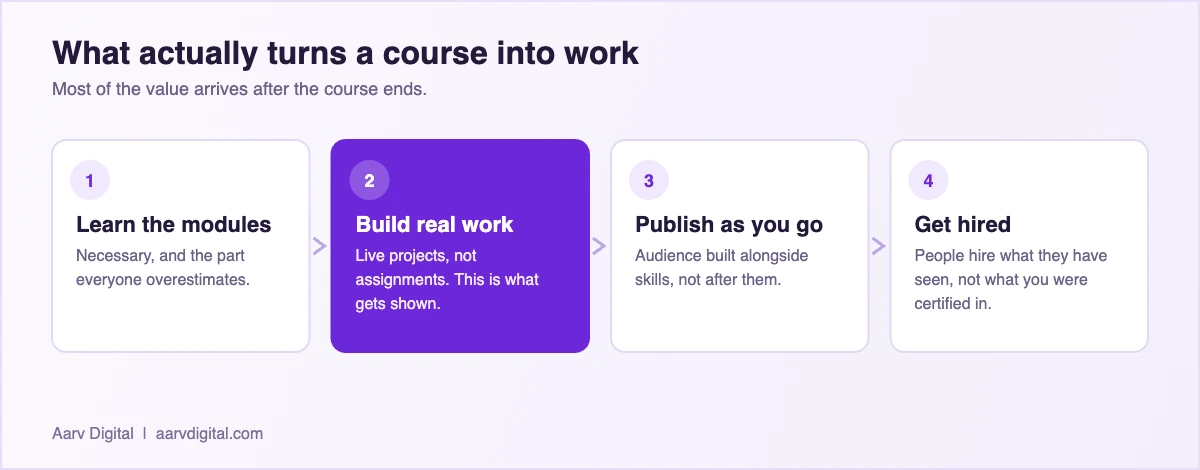
This is the single most useful question, and it is rarely answered clearly. A course that produces a portfolio of real work leaves you employable. A course that produces a certificate leaves you with a certificate. Ask specifically how many live campaigns, audits or client projects you will have completed, and what happens to that work afterwards.
Ask who is teaching and when they last did the work
Digital marketing changes faster than most syllabuses. Someone who last ran a campaign three years ago is teaching a version of the field that no longer exists, particularly where AI is concerned. It is a fair question to ask directly, and the answer tells you a great deal about how current the material will be.
Ignore placement percentages
Every institute quotes one, none of them define it the same way, and the number usually counts anyone who found any job within a generous window. It is not a lie exactly, but it is not information either. Ask instead to speak with two people who finished the course six months ago. If that request is difficult to accommodate, that itself is the answer.
Questions worth asking before you pay
- What will I have built? Specific projects, not modules covered.
- Who teaches the AI modules, and what have they shipped using those tools recently.
- How much time outside class does the course realistically expect.
- Can I speak to two past students who finished at least six months ago.
- What happens if I fall behind, because most people do at some point.
What I Would Do Differently
Looking back, the mistakes were not about effort. I put in the hours. They were about where I pointed the hours, and three of them cost me more time than the rest combined.
I would build in public from week one
I waited until I felt ready before posting anything, which meant I had months of work nobody could see. Starting to publish what I was learning from the first week would have built an audience alongside the skills rather than after them. The learning also sticks better when you have to explain it to someone.
I would pick one channel and go deep before going wide
I tried to be competent at SEO, paid ads, content and social simultaneously, and ended up shallow across all four. Depth in one area gets you hired. Breadth is something you accumulate afterwards, on someone else’s budget, once you already have a foundation to attach it to.
I would treat AI as a skill, not a shortcut
Early on I used AI to finish tasks faster. The people who got the most out of the same tools were using them to attempt harder tasks than they could otherwise handle. That is a completely different posture, and it compounds. If you want a practical sense of what that looks like in daily work, the walkthrough on using ChatGPT for digital marketing covers the workflow I settled on.
Quick Tip: Keep a running document of every problem you could not solve during the course, and revisit it monthly. Most of them become solvable within weeks as your foundation fills in, and watching that list shrink is a far better measure of progress than any assessment score.
The First Six Months After the Course
Nobody prepared me for this part, and it is where most people either build momentum or quietly drift away from the field. The course ends, the structure disappears, and what you do with the following six months matters more than your marks.
The first two months are usually spent discovering how much you do not know. Real clients have messy data, unclear goals and opinions about their own brand. Nothing in a controlled assignment prepares you for a business owner who wants leads by Friday and cannot tell you what a lead is worth to them. This phase feels like going backwards and is completely normal.
Months three and four are where the foundation starts to pay. You stop looking up the same things repeatedly, you begin to recognise which problems are actually the same problem in different clothing, and you start having opinions rather than only following process. This is also usually when the first paid work appears, often through someone who has been quietly watching you publish.
By months five and six the question changes from whether you can do the work to which work you want. That is a much better problem, and getting there is mostly about consistency rather than talent. The people I know who made it through that window were not the strongest students. They were the ones who kept publishing, kept taking small projects, and kept a list of what they still could not do.
FAQs
1. What should I know before joining a digital marketing course in Chennai?
You should understand that digital marketing includes SEO, advertising, AI, automation, content creation, and analytics.
2. Is AI taught in a digital marketing course in Chennai?
Yes. Modern programs include AI fundamentals, prompt engineering, generative AI, and automation workflows.
3. Why are projects important in a digital marketing course in Chennai?
Projects help students apply concepts, build confidence, and create practical portfolio work.
4. Does a digital marketing course in Chennai include SEO training?
Yes. Students learn on-page SEO, off-page SEO, local SEO, community SEO, and video SEO.
5. What is the role of automation in digital marketing?
Automation helps improve efficiency through workflows, lead management, chatbots, and publishing systems.
6. Is portfolio building important during a digital marketing course in Chennai?
Yes. A portfolio demonstrates practical skills and showcases your ability to execute marketing strategies.
7. Can beginners join a digital marketing course in Chennai?
Absolutely. Most programs are designed for learners from diverse educational and professional backgrounds.
8. What skills are taught in a digital marketing course in Chennai?
Students learn SEO, Google Ads, Meta Ads, AI tools, automation, content marketing, and personal branding.
9. Does a digital marketing course in Chennai include career support?
Many institutes provide placement assistance, resume guidance, LinkedIn optimization, and interview preparation.
10. Why choose Digital Scholar for a digital marketing course in Chennai?
Digital Scholar combines AI-focused learning, practical projects, portfolio building, agency-style training, freelancing support, and placement assistance.
Written by
Arvind Kumar
Founder of Aarv Digital, based in Chennai. Arvind helps local businesses and startup founders use AI to win more customers without adding headcount. New guide every three days.
Keep reading