
Marketing changes fast, and 2026 is moving faster than most years before it. Business owners who stay ahead of these shifts are the ones building lasting advantages, and staying on top of AI Marketing Trends is exactly the kind of forward-looking guidance the Best AI Digital Marketing Freelancer in Chennai provides to clients planning their next quarter.
Why These Trends Matter for Every Business
It is tempting to treat these AI Marketing Trends as a buzzword list that only applies to large enterprises with big budgets and dedicated innovation teams. That is no longer true. The tools behind most of these trends are now priced for small businesses, and the businesses that adopt them early are quietly pulling ahead of competitors still running marketing the way they did five years ago.
AI Is Moving From Optional to Expected
Customers increasingly expect fast, personalized responses and relevant offers, often within minutes of reaching out. Businesses relying only on manual marketing processes are falling behind competitors using AI to move quicker, respond faster, and personalize more precisely than a small human team could manage alone.
Smaller Businesses Can Now Compete
These trends are not just for large companies. AI has lowered the cost of sophisticated marketing enough that a small local business can now compete with players many times its size, at least in the specific channels and moments where AI tools are strongest: content production, ad optimization, and customer response speed.
Trends Move Faster Than Marketing Plans Do
The businesses that struggle most are not the ones lacking AI tools, but the ones treating their marketing plan as fixed for the year. A trend that mattered in January can shift by mid-year, and a marketing approach reviewed quarterly rather than annually adapts far more smoothly to these changes.
The Cost of Waiting Has Gone Up
A few years ago, delaying adoption of a new marketing technology meant missing a modest efficiency gain. Today, delaying adoption of AI-driven marketing capabilities means falling behind competitors who are compounding small advantages in speed, personalization, and cost every single month, making the gap harder to close the longer it is left unaddressed.
Trend 1: Hyper-Personalization at Scale
Generic email blasts and one-size-fits-all ad campaigns are steadily losing effectiveness. AI now makes it possible to tailor offers, messaging, and even product recommendations to individual customer behavior, at a scale that would have required a large data science team just a few years ago.
What This Looks Like in Practice
A returning customer might see a different homepage banner than a first-time visitor. An email campaign might automatically adjust subject lines based on what a specific segment has responded to in the past. None of this requires custom-built AI models anymore; most marketing platforms now bake basic personalization directly into their existing tools.
Where Small Businesses Can Start
Full-scale personalization is not necessary to see gains. Segmenting an email list into just three or four groups, based on purchase history or engagement level, and adjusting messaging for each group is often enough to see a meaningful lift in response rates without needing enterprise-level infrastructure.
Trend 2: Voice and Conversational Search
More customers are searching by speaking rather than typing, whether through smart speakers, phone assistants, or conversational search interfaces built directly into search engines. This changes how content needs to be written to be found.
Why This Changes SEO
Voice queries tend to be longer and more conversational than typed searches. Someone typing might search “AI marketing Chennai,” while someone speaking is more likely to ask “who is the best AI marketing freelancer near me in Chennai.” Content written to answer natural questions directly tends to perform better as this shift continues.
Practical Steps to Prepare
Structuring content around clear questions and direct answers, using an FAQ format where relevant, and writing in a natural, conversational tone all help content perform better for voice and conversational search, without requiring any special technical setup.
Trend 3: AI-Generated Video and Visual Content
Video and image production used to be one of the slowest, most expensive parts of marketing. AI tools have changed that dramatically, making it possible to produce professional-looking visuals and short video content in a fraction of the time and cost of traditional production.
What Is Realistic Today
AI-generated product visuals, short promotional video clips, and branded social media graphics are now achievable for a small business without a design team, though a human eye is still needed to keep the output on-brand and to catch anything that looks obviously artificial or off.
Where Human Oversight Still Matters
AI-generated visuals can occasionally produce odd artifacts, inaccurate text, or details that do not quite match a brand’s identity. A quick human review before publishing anything customer-facing remains essential, especially for anything involving logos, pricing, or specific product details.
Trend 4: Predictive Analytics and Churn Prevention
Rather than reacting after a customer stops buying, predictive analytics tools now flag which customers are likely to churn or which leads are most likely to convert, before it happens. This shifts marketing from reactive to proactive.
How This Helps Local Businesses
A small business using even basic predictive signals, like a customer who has not purchased in 60 days or a lead that has opened three emails but never booked a call, can prioritize outreach toward the people most likely to respond, rather than spreading effort evenly across everyone.
Getting Started Without Enterprise Tools
Most email marketing and CRM platforms now include basic predictive scoring as a built-in feature. The trend is less about needing new tools and more about actually using the predictive features already available inside tools a business may already own.
| Trend type | Adopt when | Ignore when |
|---|---|---|
| A new ad format | Your audience is already there | It is new and nobody you serve uses it yet. |
| A new AI tool | It replaces a task you already do | It creates a task you did not previously have. |
| A new platform | Your customers mention it unprompted | Only marketers are talking about it. |
| A new tactic | You can test it on one campaign | It requires restructuring everything first. |
| A new metric | It connects to revenue | It is impressive and connects to nothing. |
Trend 5: AI-Powered Chat and WhatsApp Commerce
Customers increasingly expect to complete an entire interaction, from question to purchase, inside a chat interface rather than being redirected to a website. AI-powered chatbots and WhatsApp automation are making this possible for businesses of every size.
Why This Matters for Local Businesses
In markets where WhatsApp is a primary communication channel, an AI-assisted chatbot that can answer common questions, share pricing, and even take basic bookings directly inside the chat removes friction that would otherwise cause a potential customer to drop off.
Balancing Automation and Human Touch
The most effective setups automate the repetitive first layer of conversation, answering common questions instantly, while flagging more complex or sensitive conversations for a human team member to take over. Full automation without any human fallback tends to frustrate customers with genuinely unusual requests.
Trend 6: Zero-Click Search and AI Overviews
Search engines increasingly answer questions directly on the results page through AI-generated overviews, meaning fewer users click through to a website for simple informational queries. This changes what “ranking well” actually means for a business.
What This Means for Content Strategy
Being the source cited inside an AI overview is becoming as valuable as ranking first in traditional results, sometimes more so. This rewards content that is clearly structured, directly answers specific questions, and is easy for AI systems to extract and summarize accurately.
Adjusting for This Shift
Rather than writing purely to rank, businesses increasingly need to write to be correctly understood and cited by AI systems summarizing search results. Clear headings, direct answers near the top of a section, and accurate, specific information all help with this.
Trend 7: Automated Ad Optimization
Ad platforms now handle far more of the targeting and budget optimization automatically than they did even two years ago. Manual, granular targeting is being replaced by AI systems that test and adjust audiences, placements, and budgets in real time.
What Changes for Advertisers
The advertiser’s role is shifting from manually picking every targeting parameter to providing clear creative assets, a defined goal, and a budget, then letting the platform’s AI find the right audience faster than manual testing ever could.
Where Strategy Still Matters
Automation optimizes within the boundaries it is given. Choosing the right campaign goal, writing compelling ad creative, and setting a sensible budget still require human judgment; automation handles the execution, not the underlying strategy.
Trend 8: AI Content Governance and Authenticity
As AI-generated content becomes more common, both customers and search engines are placing growing weight on signals of genuine authenticity: real experience, real local detail, and real human review, rather than generic AI output published without any editing.
Why This Trend Is a Correction, Not a Rejection
This is not a rejection of AI-assisted content. It is a correction against publishing unedited AI output without adding real value. Content that uses AI to draft faster, then adds specific local detail, real examples, and a human editing pass, continues to perform well.
What This Means Going Forward
Businesses that treat AI as a drafting assistant rather than a replacement for judgment and local expertise are the ones best positioned as search engines and customers both become better at distinguishing genuinely useful content from generic AI filler.
Trend 9: AI-Assisted Local SEO and Google Business Profile Optimization
Local search remains one of the highest-intent channels available to a small business, and AI is now changing how that visibility is earned. Google’s own AI systems increasingly decide which local businesses get surfaced for a given search, based on signals that go beyond simple keyword matching.
What AI Looks for in Local Listings
Consistency across a Google Business Profile, review responses, photo freshness, and posted updates all feed into how favorably AI-driven local search ranks a business. A profile that is filled out once and never touched again increasingly loses ground to competitors who keep their listing active.
Practical Local SEO Actions for 2026
Responding to every review, even negative ones, adding fresh photos regularly, and posting short updates about offers or changes all send freshness signals that AI ranking systems reward. None of this requires technical skill, only consistency.
Trend 10: Multimodal Search and Visual Discovery
Customers are increasingly searching using images and combinations of images and text rather than typed keywords alone. A customer might photograph a product they like and search for something similar, or combine a photo with a typed question about pricing or availability.
Why This Matters for Product-Based Businesses
Businesses that sell visually distinctive products benefit most from this shift, since clear, well-lit, accurately labeled product images become a discovery channel in their own right, not just supporting content for a listing that was already found through text search.
Getting Ready for Visual Search
Using descriptive file names, clear alt text, and high-quality images across a website and social channels all improve how well a business surfaces in visual and multimodal search, even without any specialized visual SEO tools.
How to Prioritize These Trends for Your Business
A Simple Filter for Choosing What to Adopt First
- Does this trend address a specific bottleneck you already have, such as slow response times or generic content?
- Can you test it with a small, low-risk pilot before committing significant budget?
- Does your team have the bandwidth to actually implement and monitor it properly?
- Will your specific customers notice and respond to this change, given how they actually behave?
Quick Tip
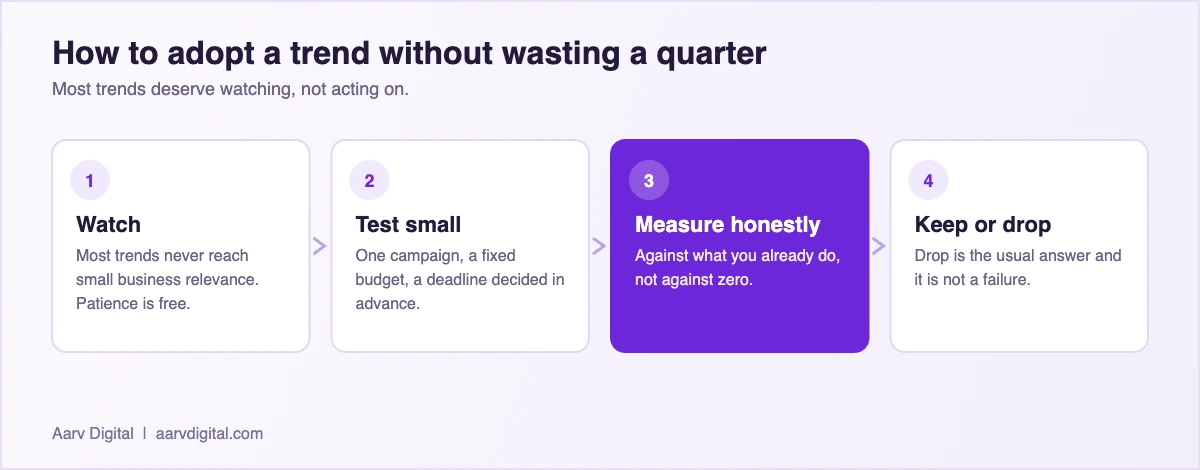
Do not chase every trend at once. Pick the one or two most relevant to your business model and execute them properly before adding more. A business that implements two trends well outperforms one that implements six trends poorly.
Turning Trends Into a Real Strategy
Reading about AI Marketing Trends is easy; building them into an actual, working marketing plan is where most businesses stall. That is the ongoing role a dedicated AI marketing consultant in Chennai plays, translating industry shifts into specific actions for your business, your customers, and your budget, rather than a generic checklist copied from an industry blog. Pairing this with practical execution, like learning how to use ChatGPT for digital marketing, turns awareness of trends into real results.
Businesses that adapt early to these shifts typically see the biggest advantage, since early adoption compounds before the trend becomes standard practice across the industry and the competitive edge narrows.
A Quarterly Framework for Staying Current
Review Every Three Months, Not Once a Year
AI marketing trends shift faster than annual planning cycles can track. A short quarterly review, looking at what changed in customer behavior, competitor activity, and available tools, keeps a marketing plan responsive without requiring constant, disruptive changes.
Test Small Before Scaling
Any new trend worth adopting should be piloted on a small scale first, whether that is testing hyper-personalization on one email segment or trying an AI chatbot on a single product line, before rolling it out across the entire business.
Keep a Simple Trend Log
A simple running document noting which trends were tested, what worked, and what did not, prevents a business from repeatedly re-testing ideas that already failed or forgetting successful experiments that deserve to be scaled further.
Common Mistakes Businesses Make With AI Trends
The most common mistake is adopting a trend because a competitor is using it, without checking whether it actually fits the business’s customers or goals. A trend that works well for an e-commerce brand may be irrelevant for a local service business, and vice versa.
The second common mistake is adopting too many trends simultaneously, spreading a small team too thin to properly implement or monitor any of them well. A narrow, well-executed approach consistently outperforms a broad, shallow one.
The third mistake is assuming a trend, once adopted, requires no further attention. AI tools and customer expectations both continue to evolve, and a personalization strategy or chatbot setup that worked well a year ago may need updating as the underlying technology and customer behavior shift.
Frequently Asked Questions
Which AI marketing trend should a small business adopt first?
Start with whichever trend addresses your most immediate bottleneck. If response time to customer questions is the issue, an AI chatbot is the natural starting point. If content production is the bottleneck, AI-assisted content and visuals make more sense first.
Are these trends only relevant for larger businesses?
No. Most of the tools behind these trends are now priced and designed for small business use, and in many cases a smaller, more agile business can implement them faster than a large company slowed down by internal approval processes.
How often do AI marketing trends actually change?
Meaningfully, roughly every quarter, though the underlying shifts, like the move toward personalization or conversational search, tend to build gradually over a year or more rather than appearing overnight.
Does adopting these trends require a large budget?
Not necessarily. Many of these capabilities are now included in the standard tiers of marketing platforms a business may already use, meaning the real cost is often the time to learn and implement them rather than new software spend.
How does the Best AI Digital Marketing Freelancer in Chennai help with this?
Beyond simply knowing which trends exist, the value comes from filtering which trends genuinely fit a specific business, piloting them safely, and integrating them into a cohesive strategy rather than adopting each trend in isolation.
What is the biggest risk of ignoring these trends entirely?
The biggest risk is not any single missed trend, but the cumulative gap that forms when competitors compound small AI-driven advantages quarter after quarter while a business continues to market the same way it did several years earlier.
Should a business track competitor AI adoption directly?
Loosely, yes. Noticing when competitors start using chatbots, personalized email campaigns, or AI-generated content is a useful signal, though the goal should be adapting trends to your own customers rather than copying a competitor’s approach exactly.
Ready to Scale Your Startup with AI-Powered Marketing?
If you are a local business owner or startup founder in Chennai looking to grow faster with smarter marketing, let’s talk. As the Best AI Digital Marketing Freelancer in Chennai, Arvind at Aarv Digital helps small businesses use AI to get more customers, save time, and scale sustainably.
Contact Arvind at Aarv Digital today to start your digital marketing growth journey — visit aarvdigital.com, follow Aarv Digital on LinkedIn, or reach out directly to book a free consultation.

Written by
Arvind Kumar
Founder of Aarv Digital, based in Chennai. Arvind helps local businesses and startup founders use AI to win more customers without adding headcount. New guide every three days.
Keep reading