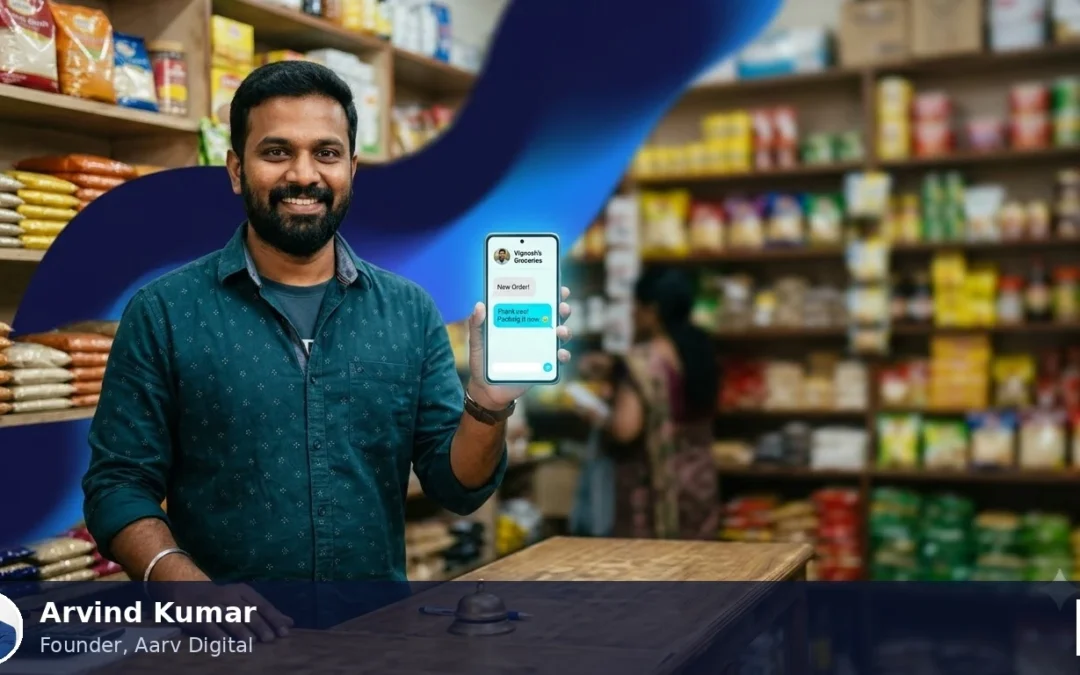
AI chatbots for local businesses are no longer a big-brand luxury. In 2026, a local bakery in Ambattur or a salon in Anna Nagar can set up an AI-powered chatbot in an afternoon and start answering customer questions, booking appointments, and capturing leads while the owner sleeps. If you run a small business in Chennai and you are tired of missing calls, replying to the same WhatsApp questions ten times a day, or losing leads because nobody answered fast enough, this guide walks you through exactly what AI chatbots are, why they matter, and how to set one up without hiring a developer.
What Is an AI Chatbot and Why Local Businesses Need One
An AI chatbot is software that uses natural language processing to understand what a customer is asking and respond in real time, without a human typing the reply. Unlike the old “press 1 for sales” bots, today’s AI chatbots are built on large language models, the same technology behind ChatGPT, so they can hold a real conversation, understand context, and even pull information from your business documents or product list.
For AI chatbots for local businesses to succeed, this matters because customer expectations have quietly shifted. People no longer wait patiently for a reply the next morning, they expect an answer within minutes, whether it is 9 AM or 11 PM. A chatbot is the only realistic way a one-person or five-person team can meet that expectation without burning out.
How AI Chatbots Differ from Old-School Chatbots
Older chatbots worked on rigid decision trees. If a customer’s question did not match one of the pre-written options, the bot would fail or loop back to a generic menu. Modern AI chatbots understand intent. A customer can type “do you have parking near your Ambattur store” in broken English or Tanglish, and the bot will still understand and answer correctly, because it is trained on language patterns, not fixed scripts.
Why Local Businesses in Chennai Are Adopting Them Fast
Chennai’s small business scene runs on WhatsApp, Instagram DMs, and phone calls. Most owners are juggling operations, staff, and marketing themselves, which means messages sit unanswered for hours. An AI chatbot closes that gap immediately. It also matches how local customers already prefer to communicate, since most people would rather message a business than call it, especially outside working hours. Add in the fact that Chennai’s traffic and long commute times mean people often browse and message businesses late at night after they get home, and the case for round-the-clock automated replies becomes even stronger.
Key Benefits of AI Chatbots for Local Businesses
Before picking a tool, it helps to understand exactly what problem an AI chatbot solves for a small, local operation. These are the benefits that actually move the needle for businesses in Chennai.
A chatbot captures the conversation. What happens afterwards decides whether it turns into revenue, and that is where email marketing automation takes over.
Round-the-Clock Customer Support
Customers browsing your website or messaging your WhatsApp Business number at 11 PM do not want to wait until 10 AM for a reply. An AI chatbot answers instantly, any time of day, which keeps interested customers engaged instead of moving on to a competitor who replied faster. In a competitive local market, response speed alone can be the deciding factor between winning and losing a customer.
Faster Lead Capture and Qualification
A well-built chatbot does not just answer FAQs, it asks the right follow-up questions to figure out if a visitor is a serious buyer. It can collect name, phone number, and requirement details automatically, then hand off only the qualified leads to you, saving hours of back-and-forth every week. Instead of scrolling through dozens of casual “just checking” messages, you open your day with a short list of people who are genuinely ready to buy.
Lower Cost Compared to Hiring Staff
Hiring a full-time customer support person in Chennai costs a meaningful monthly salary, plus training time and management overhead. Most AI chatbot platforms cost a fraction of that, and some have usable free tiers for very small businesses. For a startup founder watching every rupee, this is often the highest-leverage automation available, since it directly frees up time that would otherwise go into answering the same five questions repeatedly.
Consistent Brand Voice Every Time
A tired staff member on their eighth call of the day might sound short or distracted. A well-trained AI chatbot gives the same warm, accurate, on-brand answer whether it is the first conversation of the day or the five-hundredth, which quietly protects your reputation over time.
Types of AI Chatbots You Can Use
Not every chatbot fits every business. Here is a quick breakdown of the main types you will come across. Choosing the right AI chatbots for local businesses starts with knowing where your customers already spend their time.
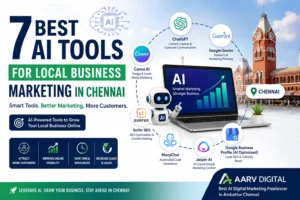
Chatbots are one line item in a wider toolkit. The shortlist of AI tools for local business puts them in context against everything else competing for the same budget.
Website Chatbots
These sit as a small chat widget in the corner of your website, answering questions about pricing, services, and availability while visitors are still browsing, which is exactly the moment they are most likely to convert. They work especially well for service businesses and consultants whose website already gets decent traffic.
WhatsApp and Messenger Bots
Since most Chennai customers already message businesses on WhatsApp, connecting an AI chatbot to your WhatsApp Business number often delivers the best return. It can handle order status questions, appointment bookings, and basic support without you touching your phone, and because it lives inside an app your customer already has open all day, engagement rates are typically much higher than a website widget.
Voice-Based AI Assistants
Still early for most small businesses, but growing fast, voice AI can answer incoming phone calls, take messages, and even book appointments over a call, which is useful for clinics and service businesses that get a high volume of phone enquiries and cannot afford to have calls go unanswered during busy hours.
Popular AI Chatbot Tools for Small Businesses
Here are some accessible, budget-friendly tools worth trying:
- Tidio — easy website chat widget with AI replies and a generous free plan, good starting point for service businesses.
- WATI — built specifically for WhatsApp Business automation, popular with Indian small businesses and retail shops.
- ManyChat — strong for Instagram DM and Messenger automation, good for retail and D2C brands running social ads.
- Chatbase — lets you train a chatbot on your own website content or PDFs in minutes, ideal if you already have detailed FAQs written up.
- Landbot — good no-code option for building conversational flows visually, useful for appointment-based businesses.
How to Set Up Your First AI Chatbot (Step-by-Step)
You do not need coding skills to launch an AI chatbot in 2026. Here is the process most small businesses in Chennai can follow in under a week.
Step 1: Define Your Chatbot’s Goal
Decide what job the chatbot is doing before you touch any tool. Is it answering FAQs, booking appointments, qualifying leads, or handling order status? Trying to make one chatbot do everything on day one usually leads to a confusing, unfocused bot that frustrates customers instead of helping them.
Step 2: Choose the Right Platform
Match the platform to where your customers already message you. If most enquiries come through WhatsApp, start there instead of building a website widget nobody uses. Look at your last month of customer messages and count where they actually came from before deciding.
Step 3: Train It on Your Business Information
Upload your FAQs, service list, pricing, and policies into the platform. Most modern tools let you paste your website URL or a PDF and the AI will learn from it directly, which is far faster than manually writing every possible question and answer. Spend extra time getting your pricing and availability information accurate here, since this is what most customers actually ask about first.
Step 4: Test and Launch
Run through real customer scenarios yourself before going live, ask tricky questions, check how it handles things it does not know, and confirm it has a clear way to pass the conversation to a human when needed. It also helps to have a friend or family member try it cold, since they will ask questions in ways you did not anticipate.
Quick Tip
Always set up a clear “connect me to a person” fallback in your chatbot. Customers trust a bot more when they know a human is one message away if the AI gets stuck.
Common Mistakes to Avoid When Using AI Chatbots
A poorly set up chatbot can hurt customer trust faster than having no chatbot at all. Watch out for these mistakes.
Making It Too Robotic
If every response sounds like a canned corporate script, customers disengage quickly. Write the chatbot’s tone the way your best staff member would actually talk to a customer, warm, direct, and local, rather than copying generic templates from an international SaaS tool.
Not Having a Human Handoff Option
AI chatbots are great at handling repetitive questions, but they should never trap a frustrated customer in an endless loop. Always give an easy way to reach a real person for complex issues or complaints, and monitor conversations regularly to catch cases where the bot is clearly struggling.
Forgetting to Update It
Prices change, new services launch, and store timings shift for festivals. A chatbot trained on outdated information does more damage than good, so treat it like a living part of your business that needs a quick monthly review.
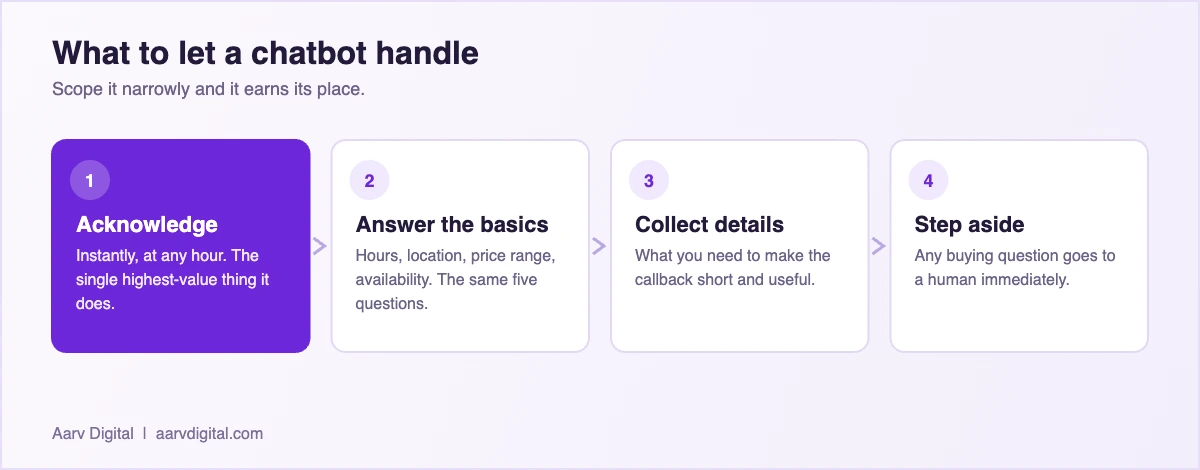
| Question type | Bot or human | Why |
|---|---|---|
| What are your hours | Bot | Factual, unchanging, asked constantly. |
| Do you cover my area | Bot | Simple lookup. Answering instantly wins the lead. |
| Roughly what does it cost | Bot, with a range | A range builds trust. Refusing to answer loses them. |
| Can you do it cheaper | Human | A negotiation. Never automate this. |
| Something went wrong | Human | A complaint handled by a bot becomes a worse complaint. |
| I want to book now | Human | The moment of decision deserves a person. |
What a Typical Chatbot Conversation Looks Like
It helps to see the flow in practice. Picture a small furniture store in Velachery running a WhatsApp chatbot. A customer messages at 9 PM asking about a dining table they saw on Instagram. The bot instantly shares the size, material, price, and delivery timeline, then asks whether the customer wants to see it in person or place an order online. If the customer asks something the bot cannot answer confidently, like a custom size request, it immediately offers to connect them with the owner the next morning and captures their phone number so nothing gets lost. By the time the store opens, the owner has a ready list of warm, pre-qualified conversations instead of a blank inbox and a guessing game about who is actually serious.
This is the real value of an AI chatbot, it is not about replacing conversation, it is about making sure no interested customer ever falls through the cracks simply because of timing.
How to Measure If Your Chatbot Is Actually Working
Setting up a chatbot is only half the job, tracking its performance tells you whether it is genuinely helping your business or just sitting there unused.
Response and Resolution Rates
Check what percentage of conversations the bot resolves on its own versus how many need a human handoff. A healthy target for most local businesses is resolving 60 to 70 percent of routine questions without any staff involvement.
Lead-to-Conversation Ratio
Track how many chatbot conversations turn into actual enquiries, bookings, or sales. If conversations are high but conversions are low, the bot may be answering questions well but failing to guide customers toward the next step.
AI Chatbots vs Other Ways to Capture Leads
Before committing budget to a chatbot, it is worth comparing it honestly against the two alternatives most Chennai businesses already use.
AI Chatbots vs Plain Contact Forms
A contact form is passive, it just sits there waiting for someone to fill it in, and most visitors simply do not bother. A chatbot is active, it starts the conversation, asks a friendly question, and pulls information out of a visitor who would have otherwise left the page without engaging at all. Businesses that switch from a static form to a chatbot widget typically see far more completed enquiries from the same amount of website traffic.
AI Chatbots vs Hiring a Virtual Assistant
A human virtual assistant is excellent for judgment calls, negotiation, and building genuine rapport, but they can only handle one conversation at a time and are unavailable outside their working hours. An AI chatbot can hold hundreds of simultaneous conversations at 2 AM on a Sunday. The two are not mutually exclusive, many growing Chennai businesses use a chatbot for the first response and a virtual assistant or the owner themselves for anything that needs a human touch, getting the coverage of automation with the warmth of a real person where it counts.
Customer Satisfaction Signals
Beyond raw numbers, pay attention to how conversations feel. Are customers thanking the bot, asking follow-up questions naturally, or dropping off mid-conversation in frustration? A quick monthly read-through of ten to fifteen random chat logs tells you more about real customer experience than any dashboard metric alone.
Real-World Use Cases for Chennai Businesses
Here is how different types of local businesses are already using AI chatbots.
Restaurants and Cafes
Answering “are you open now,” taking table reservations, and sharing today’s menu automatically, freeing up staff during peak hours when the phone would otherwise be ringing constantly.
Clinics and Salons
Booking and rescheduling appointments, sending reminders, and answering common questions about services and pricing without tying up the front desk phone line, which also reduces no-shows since reminders go out automatically.
Retail Shops
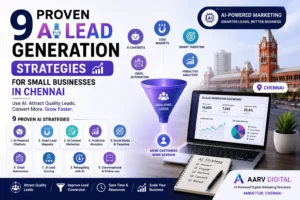
Checking product availability, sharing store location and timings, and capturing customer details for follow-up offers and festival promotions, turning casual browsers into a list you can remarket to later. This pairs well with the AI lead generation strategies already working for other Chennai small businesses.
Home Services and Contractors
Electricians, plumbers, interior designers, and other on-demand service providers in Chennai use chatbots to instantly share pricing ranges, service areas, and availability, so a customer comparing three providers at once gets an answer from you first, often before a competitor even picks up the phone.
Frequently Asked Questions
Is an AI chatbot expensive to set up for a small business?
No. Most platforms have free or low-cost starter plans, and a basic WhatsApp or website chatbot can be set up for under a few thousand rupees a month, sometimes free depending on your message volume and the platform you choose.
Can an AI chatbot reply in Tamil or Tanglish?
Yes, most modern AI chatbots built on large language models can understand and respond in Tamil, English, or a mix of both, which matters a lot for Chennai’s local customer base and makes the experience feel far more natural.
Will a chatbot replace my staff completely?
No. A chatbot handles repetitive, first-line questions so your staff can focus on complex requests, sales conversations, and in-person service, it works alongside your team, not instead of it, and usually makes existing staff more productive rather than replacing them.
How long does it take to set up an AI chatbot?
A basic version can be live within a day or two. A fully trained chatbot that handles bookings, FAQs, and lead capture smoothly usually takes one to two weeks of testing and refinement before it feels reliable enough to trust fully.
Do I need technical skills to manage it?
Not for most no-code platforms. You will need someone comfortable updating FAQs and reviewing conversations occasionally, but no coding is required to launch or maintain it on a day-to-day basis.
What happens if the chatbot gives a wrong answer?
Good platforms let you review conversation logs regularly so you can spot and correct mistakes quickly. Setting a clear human handoff option also limits the damage any single wrong answer can do, since customers always have an easy way to reach a real person.
Ready to Add an AI Chatbot to Your Business?
If you are a local business owner or startup founder in Chennai looking to grow faster with smarter marketing, let’s talk. As the Best AI Digital Marketing Freelancer in Chennai, Arvind at Aarv Digital helps small businesses use AI to get more customers, save time, and scale sustainably.
Contact Arvind at Aarv Digital today to start your digital marketing growth journey — visit aarvdigital.com, follow Aarv Digital on LinkedIn, or reach out directly to book a free consultation.

Written by
Arvind Kumar
Founder of Aarv Digital, based in Chennai. Arvind helps local businesses and startup founders use AI to win more customers without adding headcount. New guide every three days.
Keep reading