

ChatGPT for Digital Marketing is quickly becoming the single most useful AI skill a small business owner can learn. Most business owners have opened ChatGPT, typed one vague question, and closed the tab unimpressed. The gap between that experience and real marketing results comes down entirely to how you prompt it and what workflow you build around it. Working with the Best AI Digital Marketing Freelancer in Chennai means knowing exactly how to turn ChatGPT into a daily marketing assistant, not just a novelty chatbot you open occasionally when stuck.
Why ChatGPT for Digital Marketing Works So Well
ChatGPT has become the default entry point into AI for most small businesses, and for good reason. It is flexible enough to help with almost every marketing task, from writing to research to strategy thinking, without needing a dozen separate specialized tools. For a business owner without a dedicated marketing team, that flexibility is often the difference between consistently showing up online and letting marketing slide whenever things get busy, since a single familiar tool lowers the friction of getting started on any given day.
ChatGPT shortens the work, it does not replace knowing what good looks like. If you are still building that judgement, these are the things I wish I had known when I started out.
It Removes the Blank Page Problem
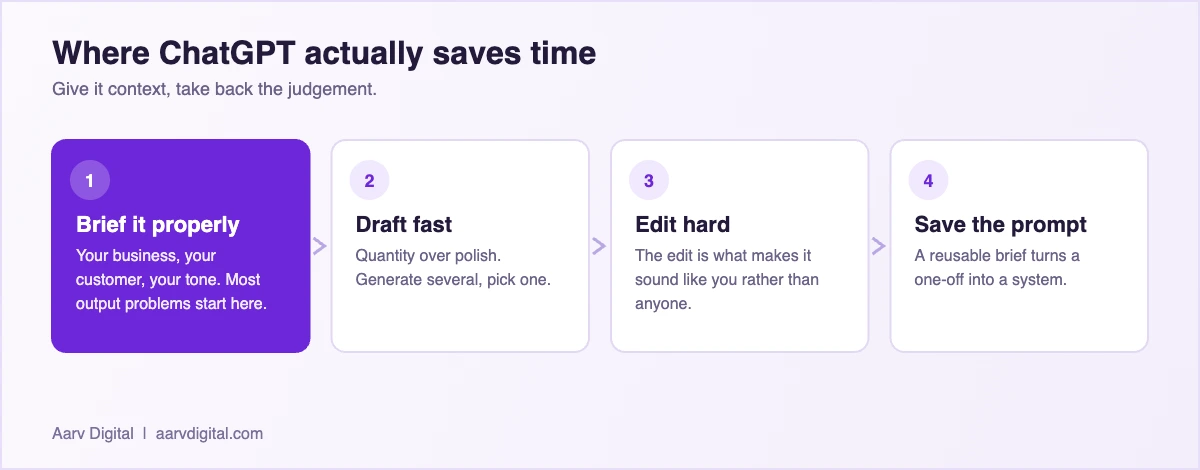
Whether it is an ad headline, an email subject line, or a week of social captions, ChatGPT gives you a strong first draft in seconds. The real work is refining that draft for your brand voice, your local audience, and your specific offer, rather than starting from nothing every single time.
It Scales Research You’d Normally Skip
Competitor analysis, customer objection lists, and content brainstorms that used to take hours can now be drafted in minutes. This does not replace real market research, but it dramatically lowers the barrier to doing at least some research before every campaign, which most small businesses previously skipped entirely due to time pressure.
Setting Up ChatGPT for Marketing Work
Give It Context First
Before asking for any content, spend five minutes giving ChatGPT context about your business: who your customers are, what makes your offer different, and what tone you want. This single step improves every output that follows, since generic prompts without context produce generic marketing copy every time. Businesses that skip this step often end up rewriting AI drafts almost entirely, which defeats much of the time-saving benefit in the first place, whereas five minutes of upfront context typically saves far more editing time later.
It is also not the only tool worth your time. The wider list of AI tools for local business covers what each one is actually good at, and where ChatGPT is the wrong choice.
Build a Reusable Brief
Save a short “business brief” as a text file you paste at the start of any new ChatGPT conversation. This should include your business name, location, target customer, tone of voice, and two or three example phrases you like. Reusing this brief saves time and keeps output consistent across weeks of use. Some businesses go a step further and keep a running list of past offers, seasonal promotions, and campaigns that worked well, pasting relevant history into a conversation when planning something similar, which helps ChatGPT avoid repeating ideas that have already been tried.
A Practical ChatGPT Marketing Workflow
Content Creation
- Drafting ad copy variations to test across Meta and Google, asking for five distinct angles per product or offer
- Writing first-draft blog outlines and social captions based on a single topic or keyword
- Turning one long blog post into a week of social media captions in different formats
- Drafting email newsletter copy, including subject line variations for A/B testing
Quick Tip
Always ask ChatGPT for multiple options rather than one final answer. Requesting three to five variations, then picking or combining the best elements, produces far stronger results than accepting the first draft.
SEO and Research
- Generating a list of long-tail keyword ideas around a core topic before writing a blog post
- Summarizing customer reviews into common themes, complaints, and praise points
- Drafting FAQ sections based on real questions customers ask, improving both usefulness and search visibility
- Researching competitor positioning by asking ChatGPT to summarize public information about rival businesses
Customer Communication
- Drafting quick, on-brand replies to common customer questions received by email or WhatsApp
- Writing polite, clear responses to negative reviews that acknowledge the issue without sounding defensive
- Creating a bank of pre-written responses for frequently asked questions that a team can adapt quickly
Strategy and Planning
- Brainstorming campaign angles for a seasonal promotion or new product launch
- Outlining a simple 30-day content calendar around a specific business goal
- Role-playing a skeptical customer to pressure-test a new offer or price point before launching it publicly
Prompting Techniques That Actually Improve Output
Be Specific About Audience and Goal
Instead of asking “write an ad for my restaurant,” specify the audience, the offer, the tone, and the desired action: “write three Instagram ad captions for a weekend lunch buffet targeting working professionals in Chennai, casual and friendly tone, ending with a clear call to book a table.” The more specific the prompt, the more usable the output.
Ask It to Critique Its Own Work
After getting a first draft, ask ChatGPT to critique its own output as if it were a skeptical customer or a strict editor. This second pass often surfaces weak phrases or unclear calls to action that were missed in the first response.
Use Follow-Up Prompts Instead of Starting Over
If a response is close but not quite right, refine it with a follow-up prompt like “make this shorter and more casual” or “add more urgency without sounding pushy,” rather than abandoning the conversation and starting fresh. This keeps context intact and usually gets to a usable result faster.
What Realistic Time Savings Look Like
Businesses that adopt a consistent ChatGPT workflow typically report saving somewhere between three and eight hours a week on content drafting, research, and internal writing tasks, depending on how much marketing content they produce. A business publishing daily social content and a weekly blog post tends to see the largest gains, since those are exactly the repetitive writing tasks ChatGPT handles well.
The time saved rarely disappears — it usually gets reinvested into the parts of marketing that genuinely need a human: talking to customers, testing new offers, and reviewing what is actually converting. Businesses that treat the saved time as an opportunity to think more strategically, rather than simply producing more low-quality content faster, tend to see the biggest long-term improvement in results.
| Task | Good use of AI? | Note |
|---|---|---|
| First drafts of posts and emails | Yes | The clearest time saving available. |
| Summarising long documents | Yes | Reliable and genuinely fast. |
| Generating variations to test | Yes | Volume is exactly what it is good at. |
| Deciding your pricing | No | It does not know your market or your costs. |
| Writing about your own results | No, without your input | It will invent plausible numbers. Supply the real ones. |
| Replying to an unhappy customer | Draft only | Send nothing here without reading it twice. |
A Sample Weekly ChatGPT Marketing Routine
Rather than using ChatGPT sporadically whenever something urgent comes up, a fixed weekly routine produces far more consistent marketing output. Here is a simple structure many small businesses adapt to their own schedule.
Monday: Planning and Content Ideas
Start the week by asking ChatGPT for content ideas tied to anything happening that week — a promotion, a local event, or a seasonal theme. Turn these ideas into a short list of planned posts, emails, or blog topics inside a content calendar for the week ahead, rather than deciding what to post the same day it goes live.
Tuesday and Wednesday: Drafting
Use these two days to draft the actual content identified on Monday: blog posts, ad copy, email campaigns, or a batch of social captions. Drafting several pieces of content in one sitting, using a consistent business brief, tends to produce more cohesive output than writing each piece in isolation on separate days.
Thursday: Review and Local Editing
This is the day to edit AI drafts for accuracy, local tone, and brand voice — adding specific details, correcting anything generic, and making sure calls to action are clear and specific to the business rather than generic marketing language.
Friday: Research and Reflection
Close the week by asking ChatGPT to help summarize how the week’s content might be improved, review any customer feedback or comments received, and brainstorm ideas for the following week. This closes the loop and keeps the following Monday’s planning session faster and more informed.
Quick Tip
This routine works whether one person handles all of it or it is split across a small team. The key is consistency — a fixed weekly rhythm produces better results over three months than sporadic, high-effort bursts followed by long gaps of no content at all.
Where Human Judgment Still Matters
ChatGPT does not know your local market, your pricing history, or what has already been tried and failed for your specific business. It also cannot verify facts about your own operations, so any specific claims, numbers, or promises in AI-drafted content need a human check before publishing.
This is exactly where a hands-on AI-driven digital marketing expert in Chennai adds real value — turning raw ChatGPT drafts into campaigns that are accurate, on-brand, and actually convert, rather than generic text that could belong to any business in any city. Pairing this with the right AI tools for digital marketing rounds out a complete AI-powered marketing stack.
10 Ready-to-Use ChatGPT Prompts for Marketing
Copy, adapt, and reuse these prompts as a starting point. Replace the bracketed details with your own business information for immediate use.
Prompts You Can Paste In Today
- “Write five Instagram caption variations for [product/offer] targeting [audience] in [city], tone: [friendly/professional/playful], each ending with a clear call to action.”
- “I run a [type of business] in [city]. Generate 15 blog topic ideas that would attract local customers searching for [core service].”
- “Summarize the following customer reviews into three common themes, three complaints, and three things customers love: [paste reviews].”
- “Write a polite, non-defensive response to this negative review that acknowledges the issue and invites the customer to resolve it privately: [paste review].”
- “Draft three subject lines and one email body for a [seasonal/promotional] email to customers who haven’t purchased in 60 days.”
- “Act as a skeptical customer considering [offer/price]. What objections would you raise, and how would you want them addressed?”
- “Turn this blog post into seven social media captions for different platforms, keeping the core message but adjusting tone and length: [paste blog post].”
- “Generate a simple 30-day content calendar for [business type] focused on the goal of [more bookings/more calls/more foot traffic].”
- “List 20 long-tail keyword phrases a potential customer might search before choosing a [type of business] in [city].”
- “Write an FAQ section answering the 8 most common questions a first-time customer would have about [product or service].”
Quick Tip
Keep a running document of prompts that worked well for your business. Over time this becomes a personal playbook that makes every new piece of content faster to produce, without having to reinvent the prompt each time.
ChatGPT Compared to Other AI Assistants
ChatGPT is not the only general-purpose AI assistant worth knowing, and different tools have different strengths depending on the task at hand.
When Claude or Gemini Might Fit Better
Claude tends to handle longer documents and more nuanced writing tasks well, which makes it useful for analyzing lengthy customer feedback or drafting more detailed strategy documents. Gemini integrates tightly with Google’s own tools, which helps teams that already live inside Google Workspace for email, docs, and scheduling.
Why Most Small Businesses Still Start With ChatGPT
Despite these alternatives, ChatGPT remains the most widely adopted starting point because of its broad plugin ecosystem, familiarity, and the sheer volume of guides and prompt examples already available online. For a business just beginning to use AI in its marketing, that familiarity meaningfully lowers the learning curve.
How This Fits Into a Bigger Marketing System
ChatGPT works best as one part of a connected system rather than a standalone solution used in isolation. Content drafted in ChatGPT still needs to flow into a scheduling tool, an email platform, or an ad account to actually reach customers, and results still need to be tracked to know what is working.
This is where the bigger picture matters: a business that pairs ChatGPT for drafting with proper SEO tools, ad platforms, and analytics — all tied together by someone who understands how they connect — sees dramatically better results than one using ChatGPT for Digital Marketing alone in a vacuum, disconnected from the rest of the marketing stack.
Measuring Whether ChatGPT Is Actually Helping
Measuring the real impact of ChatGPT for Digital Marketing matters, since it is easy to assume AI tools are saving time simply because they feel faster, without actually confirming that assumption. A short monthly check-in helps separate genuine gains from busywork that merely feels more efficient.
Track Time, Not Just Output Volume
Rather than measuring success purely by how much content gets published, track roughly how long content creation takes compared to before adopting a ChatGPT workflow. If drafting a week of social content used to take three hours and now takes one, that is a concrete, measurable win worth noting and building on.
Watch Engagement and Conversion, Not Just Publishing Frequency
Publishing more content is only valuable if it performs. Keep an eye on whether engagement, replies, click-throughs, or bookings are holding steady or improving alongside increased output. A sudden drop in engagement despite more frequent posting can be an early signal that content has started to feel generic and needs a stronger local, human editing pass.
Revisit the Business Brief Periodically
As a business evolves — new offers, new pricing, seasonal shifts — the reusable business brief used to prime ChatGPT should be updated too. A stale brief based on outdated information is one of the most common reasons AI output starts to feel slightly off after a few months of otherwise successful use.
Common Mistakes Businesses Make With ChatGPT
The most common mistake is publishing AI output without editing it at all. Even strong first drafts usually need adjustments for local tone, accurate details, and a genuinely compelling call to action — skipping this step is the fastest way to make marketing content feel obviously AI-generated.
The second common mistake is using ChatGPT only for writing tasks and ignoring its usefulness for planning and research. Some of the highest-value uses are less visible: brainstorming campaign angles, stress-testing offers, and summarizing customer feedback into clear themes.
The third mistake is treating every ChatGPT conversation as a one-off. Reusing a consistent business brief and building on previous conversations produces steadily improving output over time, rather than starting from zero with every new request.
Frequently Asked Questions
Is ChatGPT enough on its own for marketing?
For very small operations, ChatGPT alone can meaningfully improve content and planning. As a business grows, pairing it with dedicated SEO, ad, and analytics tools alongside working with the Best AI Digital Marketing Freelancer in Chennai typically produces stronger, more consistent results.
Which ChatGPT plan is worth paying for?
The free plan is enough to learn the workflows above. A paid plan becomes worthwhile once you are using it daily for real campaign work and want faster responses, longer context, and more reliable availability during busy periods.
Can ChatGPT replace a marketing freelancer or agency?
No. It is a powerful drafting and research assistant, but it cannot set strategy, understand your specific market the way a local expert does, or manage the day-to-day execution of a campaign across multiple channels.
How much time can ChatGPT actually save a small business?
Most small business owners report saving several hours a week on content drafting and research alone, once they build a consistent workflow and reusable prompts rather than starting from scratch with every task.
Does using ChatGPT hurt SEO if search engines detect AI content?
Search engines do not penalize content simply for being AI-assisted; they penalize low-quality, unhelpful content regardless of how it was produced. Content that is edited for accuracy, adds real local detail, and genuinely answers a customer’s question performs fine, whether AI helped draft the first version or not.
What’s the biggest risk of relying on ChatGPT for marketing?
The biggest risk is publishing confident-sounding but inaccurate claims about your own business, pricing, or promotions without checking them first. ChatGPT can sound authoritative even when a detail is wrong, which is why a human review step before publishing is non-negotiable.
Ready to Scale Your Startup with AI-Powered Marketing?
If you are a local business owner or startup founder in Chennai looking to grow faster with smarter marketing, let’s talk. As the Best AI Digital Marketing Freelancer in Chennai, Arvind at Aarv Digital helps small businesses use AI to get more customers, save time, and scale sustainably.
Contact Arvind at Aarv Digital today to start your digital marketing growth journey — visit aarvdigital.com, follow Aarv Digital on LinkedIn, or reach out directly to book a free consultation.

Written by
Arvind Kumar
Founder of Aarv Digital, based in Chennai. Arvind helps local businesses and startup founders use AI to win more customers without adding headcount. New guide every three days.
Keep reading