AI email marketing automation is quietly one of the highest-return moves a small business in Chennai can make in 2026, and most owners are still not using it. Email remains one of the few marketing channels a business fully owns, no algorithm can suddenly bury your list the way it can bury an organic social post, and the return on every rupee spent on email consistently outperforms almost every other channel available to a small business. What has changed recently is how much of the actual work AI can now handle: writing subject lines, personalizing content per subscriber, choosing send times, and triggering follow-ups automatically based on what someone actually does after opening an email.
This guide walks through what AI email marketing automation actually looks like for a small Chennai business, what kind of results are realistic, and how to set up your first automated sequence this week using tools that do not require a technical background to run. By the end, you should have a concrete first automation to build, a realistic sense of what results to expect, and a clear picture of the mistakes worth avoiding from the start.
Why Email Still Outperforms Almost Everything Else
It is easy to assume email is old-fashioned compared to social media or WhatsApp marketing, but the numbers tell a different story. Email marketing consistently delivers one of the strongest returns of any digital channel, commonly cited around forty times the amount spent, because you are reaching people who already chose to hear from you rather than hoping an algorithm decides to show them your post. For a small business with a limited marketing budget, that reliability matters more than almost any other consideration.
Automation only pays off if leads are entering the list in the first place. The companion piece on AI lead generation strategies covers how to fill it.
Where AI Actually Changes the Equation
Businesses using AI-assisted email tools are seeing open rates around double what manual, unoptimized campaigns typically achieve. The gap comes from several compounding factors working together: better subject lines informed by pattern recognition rather than guesswork, send times tailored to when each individual subscriber actually checks their inbox rather than one fixed time for the entire list, and automated follow-up sequences that respond to actual subscriber behavior instead of a single one-size-fits-all blast sent to everyone at once.
What AI Actually Automates in an Email Sequence
It helps to be specific about what “AI email marketing” means in practice, since the phrase gets used loosely. Four areas see the most genuine benefit: subject line generation and testing, audience segmentation based on behavior rather than static demographics, send-time optimization per subscriber, and behavior-triggered follow-up sequences that fire automatically when someone opens, clicks, or ignores a previous email.
Subject Lines: The Highest-Leverage Small Detail
Personalized, well-crafted subject lines can lift open rates by roughly a quarter compared to generic ones, and AI tools are particularly good at generating and testing several subject line variants quickly, something that would take considerable manual effort to do properly for every campaign. Rather than agonizing over one subject line, generate five options, let the platform test them against a small portion of your list, and let the data pick the winner before sending to everyone else.
Segmentation Without the Manual Spreadsheet Work
Traditional segmentation meant manually tagging subscribers based on what you remembered about them, which inevitably fell apart as a list grew past a few hundred people. AI-driven segmentation instead watches actual behavior: who opens every email versus who hasn’t opened anything in three months, who clicks through to pricing pages versus who only reads the newsletter content, who purchased once versus who purchases repeatedly. This behavioral data produces far more useful segments than any manual tagging system a small business owner has time to maintain.
Building Your First Automated Sequence
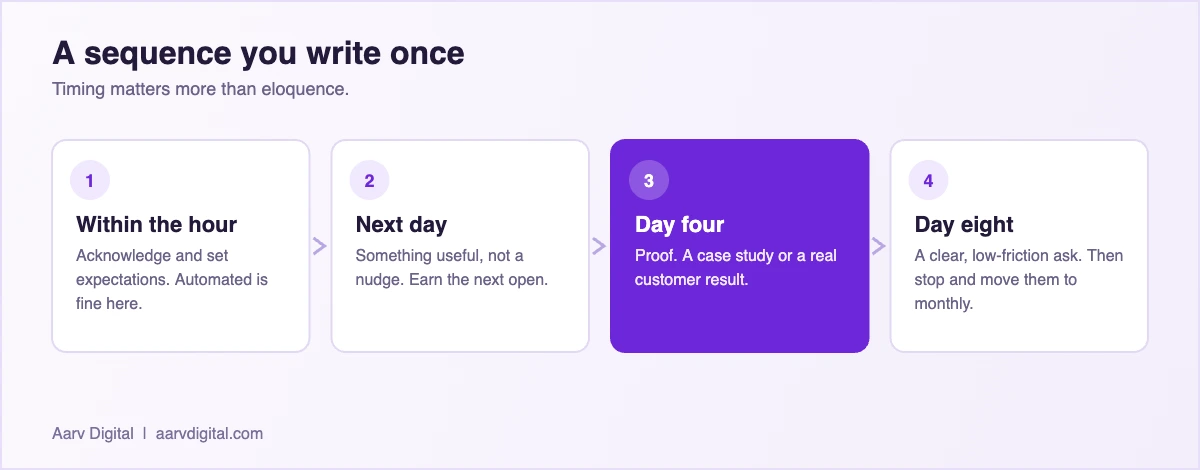
Start with the single automation that delivers the most value for the least setup effort: a welcome sequence triggered the moment someone joins your list. This is the highest-intent moment you will ever have with a new contact, and leaving it to a single generic welcome email wastes most of that opportunity.
A Simple Three-Email Welcome Sequence
The first email should arrive immediately, introducing your business and setting expectations for what subscribers will receive and how often. The second, sent two or three days later, should deliver genuine value, a useful tip, a guide, or something helpful with no sales pitch attached. The third, sent about a week after signup, can introduce your core offer or service, now that trust has been established rather than leading with a pitch to someone who barely knows your business yet.
Layering in Behavior-Triggered Follow-Ups
Once the welcome sequence exists, the next highest-value automation is a re-engagement trigger for subscribers who have gone quiet, say sixty or ninety days without opening anything. AI tools can automatically detect this pattern and send a targeted “we miss you” style email, often with a small incentive, well before that subscriber would otherwise be lost entirely and eventually unsubscribe or simply stop paying attention without you noticing.
A Practical Automation Checklist for Small Businesses
- A welcome sequence of two to three emails triggered immediately on signup
- AI-assisted subject line testing running on every campaign, not just occasionally
- Behavioral segmentation splitting your list into at least active, occasional, and inactive subscribers
- A re-engagement sequence for subscribers inactive for 60 to 90 days
- Send-time optimization enabled at the platform level rather than one fixed send time for everyone
- A monthly review of open and click rates by segment, not just an overall list average
Choosing a Platform That Fits a Small Business Budget
Mailchimp, ActiveCampaign, and similar platforms all now include meaningful AI features at reasonable price points for a small business list, automated segmentation, subject line suggestions, and send-time optimization among them. The right choice depends less on which platform has the flashiest AI branding and more on which one you will actually use consistently. A simpler tool used every week beats a powerful one that intimidates you into avoiding it after the first setup session.
What to Prioritize When Comparing Tools
Look specifically for behavior-based automation triggers, not just scheduled sends, genuine send-time optimization rather than a single global send time, and reporting that breaks results down by segment rather than only showing one blended open rate for your entire list. Most platforms offer a free tier generous enough for a small business list to test these features properly before committing to a paid plan.
Localizing Email Automation for a Chennai Audience
Generic AI-generated email content, written with no local context at all, tends to feel slightly off to a Chennai audience the same way a poorly dubbed advertisement does. Small adjustments make a real difference: referencing local festivals and seasons in your send timing and offers, being mindful of send times around major holidays when inbox attention genuinely drops, and writing in a tone that matches how you would actually speak to a customer in person rather than the more formal, slightly stiff default tone many AI writing tools default to unless specifically directed otherwise.
Getting the local detail right is most of the work here, and it is a large part of what I handle for clients as an AI digital marketing freelancer in Chennai.
Bilingual Considerations Where Relevant
For businesses whose customers are comfortable with a mix of English and Tamil in everyday communication, testing whether a slightly more conversational, locally-flavored subject line outperforms a purely formal English one is worth a genuine experiment rather than an assumption either way. AI subject line tools can generate both styles quickly, making this the kind of test that costs almost nothing to run but can meaningfully change results for a specific audience.
| Mistake | Why it costs you | Fix |
|---|---|---|
| One follow-up then silence | Most deals need four to six touches | Write the sequence once and let it run. |
| Same message to everyone | Hot and cold leads need different things | Three buckets is enough segmentation. |
| Sending only when you want something | Trains people to ignore you | Alternate useful with asking. |
| No end point | Costs goodwill and risks your sender reputation | Stop after six touches, move to a monthly list. |
| Chasing open rates | They move independently of revenue | Measure replies and booked calls instead. |
Personalization Beyond Just a First Name
Inserting a subscriber’s first name into an email has been standard practice for years and barely moves the needle anymore on its own. Genuine AI-driven personalization goes further: referencing what someone actually browsed or purchased, adjusting content based on their engagement history, and tailoring the specific offer shown based on past behavior rather than sending the identical email to every single person on the list regardless of what they have actually done.
A Realistic Starting Point
You do not need deep personalization on day one. Start by simply splitting campaigns between engaged and less-engaged segments, sending slightly different content or a different subject line to each group, and building from there as your list and your comfort with the tools both grow over time.
Common Mistakes That Undermine Email Automation
The most common mistake is setting up an automation once and never revisiting it. A welcome sequence written a year ago, referencing an old offer or a service you no longer provide, quietly damages trust with every new subscriber who receives it, and most business owners have no idea it is happening because automations run silently in the background once built. Set a calendar reminder every quarter to actually read through your active automations from a new subscriber’s perspective.
Over-Automating Too Early
A second common mistake, particularly once AI tools make automation feel effortless, is building overly elaborate sequences with a dozen branching paths before the basics are even working well. Start with the single welcome sequence and one re-engagement trigger, get comfortable with how subscribers actually respond, and only add complexity once you have a genuine reason to, driven by data rather than a desire to use every available feature a platform offers.
Ignoring Deliverability
Even the best-written, best-automated email is worthless if it lands in spam. Sending consistently, avoiding purchased or scraped contact lists entirely, and removing consistently inactive subscribers after a genuine re-engagement attempt has failed all protect your sender reputation over time. AI tools increasingly flag deliverability risks automatically, but the underlying habits of list hygiene still matter more than any single feature a platform can offer you.
Measuring Results Beyond the Open Rate
Open rate is the easiest metric to check and, on its own, one of the least useful for understanding whether email is actually growing your business. Click-through rate tells you whether your content and offers are compelling enough to act on, and conversion rate, whether that click actually became a booking, a purchase, or a genuine inquiry, is the number that connects directly back to revenue rather than just attention.
Building a Simple Monthly Review Habit
Once a month, alongside reviewing your social content calendar if you run one, spend fifteen minutes looking at which automated emails and campaigns produced actual clicks and conversions versus which ones were opened but ignored. This single habit, repeated consistently, tells you far more about what is actually working than any individual campaign’s open rate ever will on its own.
Quick Tip
Before your next campaign, ask your email platform’s AI assistant to generate five subject line variants for the same email, then run a quick A/B test on a small slice of your list before sending the winner to everyone else. This five-minute habit alone typically produces a noticeably higher open rate than picking a single subject line based on gut feeling.
Combining Email Automation With Your Other AI Marketing Channels
Email rarely works best in isolation. The same content you batch for your social media content calendar, a tip, a client result, a behind-the-scenes update, can usually be adapted into a short email with minimal extra effort, and the reverse is true too: a well-performing email topic often makes excellent social content. Treating email, social, and even WhatsApp outreach as three outputs from a single content planning session, rather than three entirely separate workstreams each demanding their own idea generation, is where AI tools genuinely compound their value for a small, time-constrained team.
A Simple Weekly Rhythm That Covers Multiple Channels
Many small businesses find it works well to batch one piece of substantial content weekly, a tip, an update, a case study, then let AI tools help adapt that single piece into a short email, two or three social posts, and a WhatsApp broadcast message, each adjusted slightly for its platform’s tone and length. This turns what might feel like three separate, competing marketing obligations into a single planning session with three outputs, which is far more sustainable for a solo owner or a small team than treating each channel as its own full-time job.
Frequently Asked Questions
How much does AI email marketing automation typically cost for a small business?
Most platforms offer AI-assisted features within their standard paid tiers, often starting well within a small business budget for lists under a few thousand subscribers, and many include a free tier generous enough to test the core automation features before paying anything.
Do I need a large email list before automation is worth setting up?
No. A welcome sequence and basic segmentation are worth setting up even with a small list, since the value comes from the structure and consistency of the automation, not the raw number of subscribers you currently have.
Will AI-written subject lines sound robotic or generic?
They can, if used unedited. Treat AI-generated subject lines as a strong starting draft to adjust in your own voice, the same way you would treat AI-drafted social captions, rather than sending them exactly as generated every time.
How often should a small business actually send emails?
Weekly or biweekly is a sustainable starting cadence for most small businesses, consistent enough to stay top of mind without overwhelming subscribers into unsubscribing from a list they otherwise wanted to stay on.
What is the single most valuable automation to set up first?
A welcome sequence. It captures your highest-intent audience at the exact moment they are most interested in hearing from you, and it requires no ongoing manual work once it is built and tested properly.
Can AI email automation replace a human writing the actual content?
It can draft a strong first version, but a human edit for voice, accuracy, and specific details still meaningfully improves how content performs, exactly as with AI-drafted social captions or blog content. Treat every AI draft as a starting point that saves you the blank-page problem, not a finished piece ready to send untouched.
What is a realistic timeline to see results from email automation?
A welcome sequence starts producing data within days, since new subscribers hit it immediately. Broader improvements in open and click rates from segmentation and send-time optimization typically become clear over four to six weeks, once the platform has enough behavioral data on your specific list to optimize against.
Ready to Turn Your Email List Into a Real Growth Channel?
If you are a local business owner or startup founder in Chennai looking to grow faster with smarter marketing, let’s talk. As the Best AI Digital Marketing Freelancer in Chennai, Arvind at Aarv Digital helps small businesses use AI to get more customers, save time, and scale sustainably.
Contact Arvind at Aarv Digital today to start your digital marketing growth journey — visit aarvdigital.com, follow Aarv Digital on LinkedIn, or reach out directly to book a free consultation.

Written by
Arvind Kumar
Founder of Aarv Digital, based in Chennai. Arvind helps local businesses and startup founders use AI to win more customers without adding headcount. New guide every three days.
Keep reading