AI Lead Nurturing is the difference between a business that collects enquiries and a business that converts them. Most small businesses in Chennai do not have a lead generation problem. They have a follow-up problem. The enquiries come in through WhatsApp, Instagram DMs, a website form, a missed call, a walk-in. Then they sit there. Three days pass. The customer buys from someone who answered faster. As the Best AI Digital Marketing Freelancer in Chennai, this is the single most common leak I find when I audit a small business, and it is also the cheapest one to fix.
This guide walks through a practical seven-step system for nurturing leads with AI, built for owner-run businesses with small teams and smaller budgets. No enterprise software, no six-month implementation. Just a workflow you can put in place over a weekend and run with one person.
What AI Lead Nurturing Actually Means
AI Lead Nurturing starts from an old idea: lead nurturing is everything that happens between the moment someone raises their hand and the moment they buy. For most businesses that window is somewhere between two days and two months. What you do in that window decides your conversion rate far more than the ad creative that brought them in.
AI does not change the fundamentals. People still buy from businesses they trust, at the moment they are ready. What AI changes is your capacity. One person can now run the follow-up quality of a five-person team, because the drafting, the sorting, the reminding and the personalising happen automatically.
Nurturing is not spamming
Worth saying clearly, because this is where most attempts go wrong. Sending the same promotional message to your whole contact list every Friday is not nurturing. It is broadcasting, and it trains people to ignore you. Real nurturing is sequenced, relevant and tied to what that specific person asked about. A customer who enquired about bridal packages should not be getting your corporate catering offer.
The test is simple. If a message would feel strange arriving from a human colleague who remembered the earlier conversation, it is wrong. Fix the message, not the send volume.
Where AI genuinely helps
Be honest about what the technology is good at. AI is excellent at pattern work: summarising a conversation, drafting a reply in the right tone, ranking which leads look serious, spotting who has gone quiet, translating a message into Tamil, generating five subject line variants. It is poor at judgement calls, pricing negotiation, and anything requiring a relationship. Use it for the first list and keep the second list human.
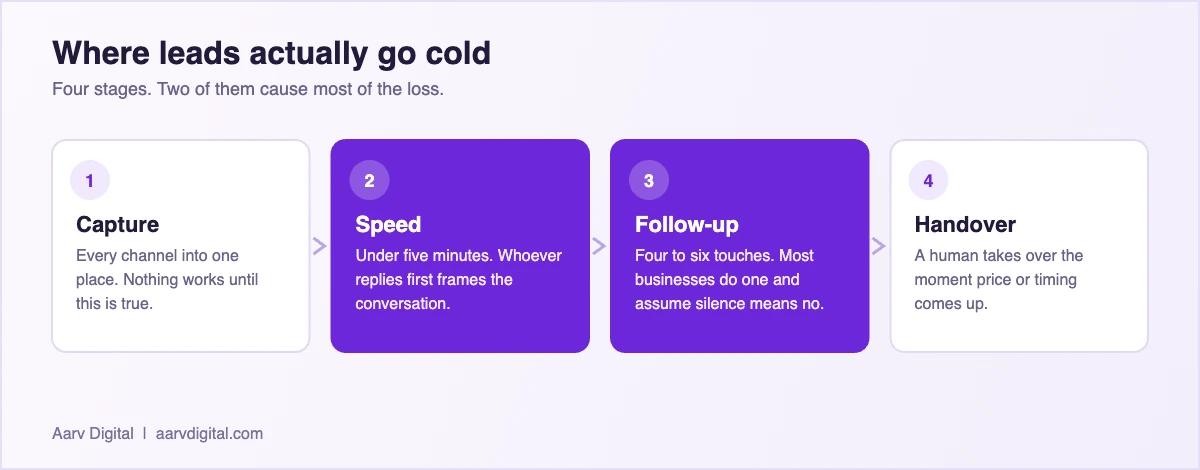
Why Most Small Business Leads Go Cold
Before building the system, it helps to understand exactly where leads die. In my experience auditing small businesses across Chennai and the wider market, the losses are remarkably consistent.
The speed problem
Response time is the most underrated metric in small business marketing. A Harvard Business Review study of thousands of enquiries found that companies contacting leads within the first hour were dramatically more likely to qualify them than those who waited even a few hours longer, and the drop-off after that is steep. You can read the original research on Harvard Business Review.
The intuition holds up. Someone filling a form at 9pm is comparing three vendors at 9pm. Whoever replies first frames the conversation. By morning, the decision is half made and you are arguing against someone else’s quote.
The memory problem
The second killer is forgetting. A lead says “call me after Diwali.” Nobody writes it down. Diwali passes. The lead is gone, not because they were not interested, but because nobody remembered. Multiply that by forty enquiries a month and you are throwing away a meaningful share of your revenue on admin failure alone.
The five places leads leak
- No single inbox. Enquiries scattered across WhatsApp, Instagram, email and a notebook, with no one view of who is waiting.
- Slow first response. Hours or days between enquiry and reply, usually because the owner is doing the actual work of the business.
- One follow-up and stop. Most deals need four to six touches. Most businesses do one and assume silence means no.
- No segmentation. Hot, warm and cold leads treated identically, so the serious buyer gets the same generic message as the price-checker.
- Dead list. Hundreds of old enquiries sitting in a phone, never contacted again, worth more than the next month of ad spend.
The 7-Step AI Lead Nurturing System
Here is the system. Build it in order. Each step is useful on its own, so you get value from step one without waiting to finish step seven.
Filling the top of this system is a separate discipline. The nine tactics in the guide to AI lead generation strategies cover where the enquiries come from in the first place.
Step 1: Capture every lead in one place
Nothing else works until this is true. One sheet, one CRM, one board, it does not matter which, but every enquiry from every channel lands in the same place with the same fields: name, phone, channel, what they asked about, date, status.
The cheapest version is a Google Sheet with a WhatsApp Business catalogue link and a website form feeding into it via a free automation tool. The better version is a lightweight CRM. Do not overbuy here. A tool nobody updates is worse than a sheet everybody updates.
Step 2: Respond in under five minutes
This is where AI earns its place immediately. An AI chat assistant on your website and WhatsApp can acknowledge every enquiry instantly, answer the four or five questions you get constantly (price range, timelines, location, availability) and collect the details you need before a human ever looks at it.
The goal is not to replace you. The goal is to hold the lead’s attention for the twenty minutes it takes you to get free. An instant, useful, correctly-toned reply does that. I covered the setup in detail in the guide to AI chatbots for local businesses.
Step 3: Score and segment your leads
Not every enquiry deserves the same effort. Feed your lead list to an AI tool with a simple instruction: rank these by likelihood to buy in the next thirty days, based on what they asked, how specific they were, and whether they mentioned budget or timeline. You will get a usable ranking in seconds.
Three buckets is enough. Hot leads get a personal call today. Warm leads get a sequence. Cold leads go on the monthly value email. The mistake is treating your list as one undifferentiated pile, which guarantees you underserve the buyers and overserve the browsers.
Step 4: Write the follow-up sequence once
Sit down once and write a four to six message sequence for each of your main service lines. Message one within an hour. Message two next day with something useful, not a nudge. Message three on day four with proof, a case study or a customer result. Message four on day eight with a clear, low-friction ask.
AI drafts these in minutes if you give it the raw material: your service details, a real customer story, your actual tone. Then you edit. Always edit. The draft gets you to eighty percent and your edit is what makes it sound like a person from your city rather than a template.
Step 5: Move between channels deliberately
Email alone underperforms in the Indian small business market. WhatsApp is where the conversation actually happens, and a well-timed voice note outperforms almost anything typed. Build your sequence across channels: WhatsApp for speed and reminders, email for detail and documents, a phone call for the moment of decision.
Effective AI Lead Nurturing means the same person receives a coherent story across all three, not three disconnected campaigns. My post on WhatsApp marketing with AI goes deeper on the channel mechanics.
Step 6: Re-engage the dormant list
Almost every business I work with is sitting on a list of old enquiries they have written off. Those people had budget and intent at some point. Many still do. A single well-written re-engagement message to a list of three hundred old leads routinely produces more booked calls than a month of cold ad spend, at effectively zero cost.
Ask AI to draft a short, non-pushy message referencing the original enquiry, and send it in small batches so you can handle the replies. Do this once a quarter.
Step 7: Hand over to a human at the right moment
Define the trigger in advance. The moment someone asks about price, availability for a specific date, or says anything that sounds like a decision, the automation stops and you take over. Nothing damages trust faster than an obviously automated reply to a serious buying question.
Quick Tip: Before you automate anything, write down the last ten enquiries you lost and why. Nine times out of ten the answer is speed or forgetting, and both are solved by step one and step two alone. Build those first and measure for two weeks before adding anything else.
The Tool Stack That Works on a Small Budget
You do not need expensive software. You need three things that talk to each other: a place to store leads, a way to send messages, and an AI layer to draft and sort.
A free and low-cost starting point
Start with WhatsApp Business for conversations, a free CRM tier or a well-structured Google Sheet for storage, a free automation tool to connect your website form to that sheet, and a general AI assistant for drafting and scoring. Total monthly cost at this stage is close to nothing, and it will handle up to roughly a hundred leads a month comfortably.
Most small businesses never need to go beyond this. If you are doing under a hundred enquiries a month, spending on a full marketing automation platform is money that would do more work in ads or content.
When to upgrade
Upgrade when one of three things is true: you are consistently above a hundred leads a month, you have more than one person handling follow-up and they are stepping on each other, or you genuinely cannot see which channel is producing revenue. Until one of those is true, added software mostly adds admin.
What to Measure
An AI Lead Nurturing system you do not measure is a system you cannot improve. Keep it to four numbers and review them weekly. This takes fifteen minutes.
The four numbers that matter
- First response time. Median minutes from enquiry to first human or AI reply. Target under five minutes.
- Touches per lead. Average number of follow-ups before a lead converts or is closed. If this is one, that is your whole problem.
- Enquiry to conversation rate. What share of enquiries turn into a real back-and-forth. This is what nurturing directly moves.
- Conversation to customer rate. What share of real conversations become paying customers. This is a sales and pricing signal, not a marketing one.
A simple weekly review
Every Monday, look at the four numbers and one qualitative question: which leads went quiet this week and what was the last thing we sent them. That question alone will show you which message in your sequence is killing momentum. Fix that one message before you touch anything else. For a broader framework on attribution and returns, see my post on measuring marketing ROI using AI tools.
| Metric | What good looks like | What it tells you |
|---|---|---|
| Median first response time | Under 5 minutes | Whether the speed problem is fixed. The fastest win available. |
| Touches per lead | 4 to 6 before closing | If this is 1, that is your entire problem in one number. |
| Enquiry to conversation rate | Rising month on month | Whether your messaging earns a reply at all. |
| Conversation to customer rate | Stable or rising | A sales and pricing signal, not a marketing one. |
| Dormant list size | Shrinking quarterly | Money sitting in your phone that nobody has contacted. |
Common Mistakes to Avoid
Three mistakes account for most failed attempts at AI Lead Nurturing in small businesses.
For local service businesses, a well-maintained Google Business Profile is usually the single largest source of the enquiries this system then has to handle.
The first is automating before the process exists. If your follow-up is chaotic manually, automating it produces faster chaos. Write the sequence on paper first, run it by hand for two weeks, then automate what works.
The second is over-personalising in a way that feels invasive. Referencing someone’s exact browsing behaviour reads as surveillance, not service. Reference what they told you, nothing more.
The third is never turning it off. Set an end point for every sequence. If someone has not responded after six touches, move them to the quarterly list. Continuing past that costs you goodwill and, on WhatsApp, risks your number.
A Worked Example: What This Looks Like in Practice
Theory is easy to nod along to, so here is a concrete picture. Take an interior design studio in Chennai getting forty enquiries a month across Instagram, a website form and referrals. Before any system, the owner replies when she gets a break between site visits, usually the same evening, sometimes the next day. She follows up once. Around four of those forty become clients.
What changes in week one
Every enquiry now lands in one sheet, tagged by source and by what the person asked about. A chat assistant on the website and WhatsApp acknowledges each enquiry immediately, shares the three price bands, asks for the property size and location, and tells them she will call personally within the day. Nothing else changes yet.
The effect is not magic, it is just presence. Leads who would have drifted to a competitor by morning are still in the conversation when she calls. And she now walks into every call already knowing the budget band and the site size, which shortens the call and sharpens the quote.
What changes in month two
Now the sequence goes in. Day one, an acknowledgement and a question. Day two, a short WhatsApp album of three completed projects in a similar budget band. Day four, a voice note answering the objection she hears most, which is timeline. Day eight, a direct ask for a site visit with two time slots. Cold leads drop to a monthly email with one useful idea in it.
She also sends one re-engagement message to two hundred old enquiries from the past year. That single message, costing nothing, produces more booked site visits than her last month of boosted posts.
Where the effort actually goes
Worth being clear about the cost side. Setting this up took her a weekend of writing and about four hours of configuration. Running it takes roughly twenty minutes a day, mostly answering the leads the system has warmed up for her. The AI does not close anything. It just makes sure that by the time she speaks to someone, that person already knows who she is and what she does.
What to build first if you only have one weekend
- Saturday morning: one sheet, every channel feeding into it, every past enquiry from the last six months added.
- Saturday afternoon: the instant-reply assistant on your website and WhatsApp, answering your five most common questions.
- Sunday morning: write the four-message sequence for your single biggest service line. Just one. Do the others later.
- Sunday afternoon: send the re-engagement message to your dormant list in batches of fifty, so you can handle the replies.
Frequently Asked Questions
How long should a lead nurturing sequence run?
For most small business services, four to six touches over two to three weeks, then a move to a low-frequency list. For high-consideration purchases like property, education or weddings, extend the sequence to two or three months with lower frequency, roughly one useful message a week.
Will customers know they are talking to AI?
Often yes, and that is fine as long as the AI is doing an appropriate job. People accept an instant automated acknowledgement. They do not accept being handled by a bot when they are ready to spend money. Be transparent, and hand over to a human early.
Can I do this without any paid tools?
Yes. A Google Sheet, WhatsApp Business, a free automation tier and a free AI assistant will run this entire system for a business doing under a hundred leads a month. The constraint is your discipline in updating it, not the software.
How do I nurture leads in Tamil and English together?
Tag language preference at capture. AI handles translation well for straightforward follow-up messages, but have a native speaker review your core sequence once, because tone and formality in Tamil do not translate mechanically. Once reviewed, the sequence runs on its own.
What is a realistic improvement to expect?
It depends entirely on where you start. A business responding within a day and following up once will usually see a clear lift from simply moving to a five-minute response and four touches. A business already doing both will see smaller gains. Measure your baseline for two weeks first so you know what actually changed.
Does this work for B2B as well as consumer businesses?
Yes, with a longer sequence and more substance in each message. B2B buyers need proof, references and documents rather than urgency. The structure is identical, the content is heavier, and the handover to a human happens earlier.
Start Fixing the Leak This Week
If you take one thing from this guide, make it this: your next customer is probably already in your phone, waiting for a reply you have not sent. AI Lead Nurturing is not a growth hack. It is basic business hygiene, made possible for a one-person team by tools that did not exist three years ago.
If you are a local business owner or startup founder in Chennai looking to grow faster with smarter marketing, let’s talk. As the Best AI Digital Marketing Freelancer in Chennai, Arvind at Aarv Digital helps small businesses use AI to get more customers, save time, and scale sustainably.
Contact Arvind at Aarv Digital today to start your digital marketing growth journey, visit aarvdigital.com or reach out directly to book a free consultation.

Written by
Arvind Kumar
Founder of Aarv Digital, based in Chennai. Arvind helps local businesses and startup founders use AI to win more customers without adding headcount. New guide every three days.
Keep reading