AI Google and Meta Ads Optimization is closing the gap between what large companies with dedicated media teams can achieve and what a small business in Chennai can run on its own, often with a fraction of the monthly budget. Local businesses using well-optimized paid ad campaigns commonly see returns in the range of two hundred to six hundred percent, and businesses using AI-driven optimization tools specifically are reporting even stronger improvements in return on ad spend within just a few weeks of proper setup.
This guide walks through what AI actually changes about running Google and Meta ads, how to decide where to put your limited budget, and a realistic first-month setup for a small business that has never run paid ads before, or has tried and gotten discouraging results. By the end, you should have a clear sense of which platform to start with, what a realistic budget looks like, and the specific mistakes that quietly waste the most money in a first campaign.
Why AI Google and Meta Ads Optimization Matters for a Small Business
Organic reach on every major platform has been shrinking for years, and paid ads remain one of the few reliable ways to guarantee your business gets in front of the exact audience most likely to buy from you, rather than hoping the algorithm favors your content today. For a small business with a limited runway, that reliability and control over targeting is worth the investment, provided the campaign is actually set up and optimized correctly.
This is part of a broader pattern rather than a one-off change, which I set out in the overview of AI marketing trends shaping small business marketing right now.
The Return on Ad Spend Math Genuinely Works
Businesses running Google Ads commonly see an average return of roughly two dollars in revenue for every dollar spent, and that ratio improves further once AI-driven optimization is layered on top of a well-structured campaign. These are not guaranteed numbers for every business, but they represent a realistic range achievable with proper setup rather than a rare best-case outcome.
What AI Actually Changes About Running Ads
A significant share of search ad spend now runs through AI-driven campaign types on Google, and Meta’s advantage+ style campaigns rely on similar machine-learning optimization. What this means practically is that AI is now handling a large portion of the moment-to-moment bidding, audience targeting, and creative testing that used to require a dedicated media buyer checking the dashboard multiple times a day. This is the core of AI Google and Meta Ads Optimization in practice.
Ad platforms are only one part of the stack, though. If you are still assembling the rest of it, the shortlist of AI tools for local business covers what is worth paying for and what is not.
Automated Bidding Removes the Guesswork
Manually setting and adjusting bids for every keyword or audience segment used to be one of the most time-consuming parts of running ads. AI-driven automated bidding strategies now handle this in real time, adjusting how much to bid based on the likelihood a specific impression will convert, something no human manager could realistically track across hundreds of auctions happening every minute.
Creative Testing at a Scale No Human Could Match
Both Google and Meta’s AI systems can now test multiple headline, image, and copy combinations simultaneously, automatically shifting spend toward whichever combination performs best for each specific audience segment. This used to require manually building and comparing dozens of ad variations; AI tools now do this continuously in the background for the entire life of a campaign.
Choosing Between Google Ads and Meta Ads
The right platform depends heavily on your business type and how customers actually search for what you offer. Google Ads captures people actively searching with clear buying intent, someone typing “AC repair near me” is often ready to book immediately. Meta Ads work differently, reaching people based on interests and behavior before they have started actively searching, which suits businesses selling something people did not know they wanted yet.
A Simple Way to Decide Where to Start
If your business fulfills an obvious, searched-for need, a plumber, a clinic, a repair service, Google Ads is usually the stronger starting point since it captures existing demand directly. If your business sells something more discovery-driven, a boutique product, a unique service, a new restaurant concept, Meta Ads often performs better since it can introduce your business to people who did not know to search for it yet.
A Practical AI Ads Setup Checklist
- Start with one platform, Google or Meta, rather than splitting a small budget across both immediately
- Use AI-driven campaign types like Performance Max or Advantage+ rather than manual legacy campaign structures
- Let AI creative testing run for at least two weeks before judging which ad variations are winning
- Set a realistic daily budget you can sustain for a full month, not just a few days
- Track conversions, not just clicks, connecting ad spend to actual bookings or sales
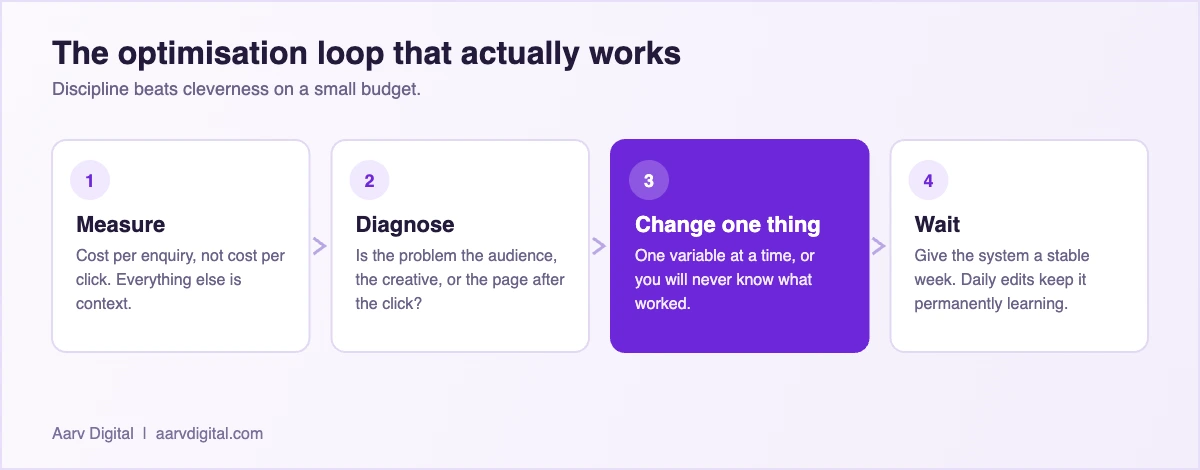
- Review performance weekly, but avoid making major changes more than once every two weeks
Setting a Realistic Budget for Your First Campaign
Effective AI Google and Meta Ads Optimization starts with the budget. A common mistake is starting with a budget so small that the AI systems never gather enough data to optimize properly. Most platforms need a minimum volume of conversions each week to learn effectively, so a budget that is spread too thin across multiple campaigns or platforms often underperforms compared to a single, adequately funded campaign.
Smart Budget Allocation Between Platforms
Once you have validated one platform is working, thoughtfully splitting budget between Google and Meta can meaningfully improve your overall blended return, since each platform tends to capture a different stage of the customer’s decision process. This is a second-month decision, not a first-week one; validate a single platform works before splitting your budget across two.
Writing Ad Copy That Works With AI Optimization
AI creative tools can generate a strong set of starting headlines and descriptions from a simple prompt describing your offer, but the strongest-performing ads still benefit from specific, concrete details only you know about your business: an actual price point, a specific guarantee, a genuine customer result.
Let AI Generate Options, You Choose the Winners
Rather than writing one ad and hoping it works, use AI copy tools to generate eight to ten headline variations and let the platform’s own testing determine which resonates, rather than guessing yourself. This approach consistently outperforms manually picking a single headline based on personal preference.
Quick Tip
Before launching your next campaign, ask an AI copywriting tool to generate ten headline variations built around a single specific detail, a price, a guarantee, a delivery time, rather than generic claims like “best service in Chennai.” Specific, concrete headlines consistently outperform vague ones in AI-optimized testing.
| Symptom | Usual cause | What to change |
|---|---|---|
| Clicks are cheap, enquiries are not | The page after the click | Send traffic to a matching page, cut the form. |
| Impressions high, clicks low | The creative or the offer | Rewrite the first line. Lead with the specific, not the clever. |
| Good enquiries, too few of them | Budget or audience too narrow | Widen the audience before raising spend. |
| Everything worked, then stopped | Creative fatigue | New creative, same targeting. Test before the decline, not after. |
| Results swing wildly week to week | Budget too small to learn | Consolidate campaigns rather than splitting further. |
Common Mistakes Small Businesses Make With AI Ads
The most common mistake is turning off a campaign too early because it has not produced results within the first few days. AI-driven campaigns typically need one to two weeks of a learning period before performance stabilizes, and judging a campaign during this window usually leads to premature, incorrect conclusions about what is or is not working.
Ignoring Conversion Tracking Setup
Without properly configured conversion tracking, AI optimization systems have no signal to actually optimize toward, and effectively run blind, chasing clicks rather than the outcomes that matter to your business. Setting up conversion tracking correctly before launching a campaign is not optional; it is the single most important technical step in the entire process.
Fighting the Algorithm Instead of Trusting the Learning Period
Constantly pausing, editing, and relaunching a campaign resets the AI’s learning process each time, meaning it never accumulates enough data to optimize properly. Once a campaign is launched with a reasonable budget and good creative, resist the urge to make daily changes and let the system gather the data it needs.
Measuring Success Beyond Cost Per Click
Cost per click is the easiest number to check and, on its own, tells you almost nothing about whether your ads are actually growing your business. Cost per conversion, and ultimately return on ad spend, are the numbers that connect your ad budget directly back to revenue rather than surface-level engagement metrics. This is where AI Google and Meta Ads Optimization proves its value most clearly.
Building a Simple Monthly Review Habit
Once a month, review cost per conversion and overall return on ad spend across your campaigns, comparing this month against last, rather than obsessing over daily fluctuations that are often just normal noise in the auction system. This monthly rhythm reveals genuine trends that daily checking simply cannot show you.
Combining Paid Ads With Your Other AI Marketing Efforts
Paid ads perform best when they are not the only thing carrying your marketing. The same offers and messaging you test in ads often make excellent organic social content, and a strong-performing ad creative can be repurposed into an email or WhatsApp broadcast with minimal extra effort. Treating paid ads as one channel within a connected marketing system, rather than an isolated project, is where a small, time-constrained team gets the most value from AI tools across the board.
Retargeting Website Visitors With AI-Optimized Ads
Visitors who came to your website but did not convert represent one of the highest-value audiences available for a retargeting campaign, since they have already shown genuine interest. AI-driven retargeting campaigns can automatically adjust messaging and bids for this warm audience, often producing a noticeably higher conversion rate than cold-audience campaigns targeting people who have never heard of your business.
Localizing Ad Campaigns for a Chennai Audience
Generic, one-size-fits-all ad copy tends to underperform compared to ads that speak directly to the local context a Chennai customer actually lives in. Referencing specific neighborhoods you serve, local landmarks, or seasonal moments relevant to your industry in your ad copy and targeting makes the difference between an ad that feels mass-produced and one that feels genuinely relevant to the person seeing it.
Language and Tone Testing
For audiences comfortable moving between English and Tamil, testing ad variations with a more locally-flavored tone against a purely formal English version is worth a genuine experiment rather than an assumption either way. AI copywriting tools can generate both styles quickly, and the platform’s own testing will reveal which resonates better with your specific audience at very little additional cost.
Geo-Targeting Refinement Beyond the City Level
Many small businesses set their geo-targeting to cover all of Chennai when their actual service area is a handful of specific neighborhoods. Narrowing geo-targeting to the areas you genuinely serve well, rather than the broadest possible radius, typically improves both cost efficiency and conversion rate, since the AI system is no longer spending budget showing ads to people well outside your realistic service area.
Understanding How AI Ad Auctions Actually Work
It helps to have at least a basic understanding of what is happening behind the scenes, even when AI is handling most of the moment-to-moment decisions. Every time someone is eligible to see an ad, an automated auction runs in milliseconds, weighing your bid, your ad’s predicted relevance and quality, and the likelihood of a conversion, to decide whose ad actually gets shown.
Why Quality Score and Relevance Still Matter
A higher-quality, more relevant ad can win auctions against competitors bidding more money, simply because the platform’s AI predicts it will perform better for that specific user. This is precisely why generic, low-effort ad copy underperforms even with a larger budget behind it: the AI system itself favors genuinely relevant, well-targeted ads over ads that are simply outspending the competition.
Frequently Asked Questions
How much should a small business budget for its first AI-optimized ad campaign?
Enough to generate a meaningful number of conversions within a month, typically starting around a few thousand rupees per day depending on your industry’s cost per click. A budget that is too thin to gather data usually underperforms compared to a smaller number of well-funded campaigns. Getting this right is the foundation of good AI Google and Meta Ads Optimization.
Should I use Google Ads, Meta Ads, or both when starting out?
Start with whichever platform best matches your business type, search-intent-driven businesses toward Google, discovery-driven businesses toward Meta, and validate results on one platform before splitting budget across both.
How long does it take AI-optimized campaigns to start performing well?
Most platforms need one to two weeks of a learning period before performance stabilizes. Judging results before this window closes usually leads to premature and inaccurate conclusions about a campaign’s real potential.
Do I still need to write my own ad copy if AI can generate it?
AI-generated copy is a strong starting point, but the best-performing ads still include specific, concrete details about your actual business that only you know, a real price, a real guarantee, a real result.
What is the single most important technical step before launching ads?
Setting up conversion tracking correctly. Without it, AI optimization systems have no reliable signal to optimize toward and effectively run blind, regardless of how much budget is behind the campaign.
Can AI ad tools replace hiring a media buyer entirely?
For many small businesses, AI-driven campaign types combined with a reasonable understanding of the fundamentals covered here can produce strong results without a dedicated media buyer. More complex, multi-platform campaigns at higher budgets still benefit from experienced human oversight.
Will my ad costs keep rising as more businesses adopt AI optimization?
Increased competition in AI-optimized auctions can raise costs over time in popular categories, but businesses with genuinely relevant, well-targeted ads tend to be more insulated from rising costs than those relying purely on outbidding competitors, since relevance remains a major factor in the auction itself.
How do I know if my ad budget is too small to work properly?
If your campaign is not generating at least a handful of conversions per week, the AI system likely does not have enough data to optimize effectively. Consolidating a thin, spread-out budget into a single well-funded campaign is usually a better first step than adding more platforms.
Ready to Make Your Ad Budget Work Harder?
If you are a local business owner or startup founder in Chennai looking to grow faster with smarter marketing, let’s talk. As the Best AI Digital Marketing Freelancer in Chennai, Arvind at Aarv Digital helps small businesses use AI to get more customers, save time, and scale sustainably.
Contact Arvind at Aarv Digital today to start your digital marketing growth journey — visit aarvdigital.com or reach out directly to book a free consultation.

Written by
Arvind Kumar
Founder of Aarv Digital, based in Chennai. Arvind helps local businesses and startup founders use AI to win more customers without adding headcount. New guide every three days.
Keep reading