

After the foundation and the creative are in place, the last piece is the one most founders get wrong: money. Meta Ads budget strategy is where good campaigns quietly die, either because the budget was too thin to ever gather useful data, or because spend was scaled up too aggressively and torched a month’s runway on an unproven concept.
This final post in the series covers how to set a realistic starting budget, how to scale spend once something is working, and how to think about return on ad spend in a way that keeps a startup’s paid marketing genuinely profitable rather than a recurring cash drain. The Meta Ads budget strategy laid out here builds directly on the account setup covered in our Meta Ads for startups foundation guide and the Meta Ads creative ideas post earlier in this series.
Why Meta Ads Budget Strategy Matters More Than Most Founders Realize
It is tempting to treat budget as a simple dial: spend more, get more results. In practice, Meta’s delivery system behaves very differently depending on how a budget is structured, how quickly it changes, and how it is split across campaigns. A well-structured Meta Ads budget strategy is often the difference between a campaign that compounds in efficiency over time and one that never escapes the learning phase.
The Learning Phase and Why Budget Stability Matters
Every new ad set enters a learning phase where Meta’s delivery system is actively testing and gathering signal. Meta’s own guidance suggests an ad set generally needs around fifty conversion events within a week to exit this phase efficiently. A budget too small to generate that volume means the ad set can remain stuck in an inefficient learning state indefinitely, spending money without ever reaching stable, optimized delivery.
Setting a Realistic Starting Budget
Before opening Ads Manager, it helps to work backward from your own numbers rather than picking a budget arbitrarily.
Budget decisions only make sense against what a customer is actually worth to you. The framework for working that out is in the guide to measuring marketing ROI with AI.
Working Backward From Customer Value
Start with what a customer is actually worth to your business, then work out what cost per result keeps the campaign profitable. If a customer’s lifetime value is two thousand rupees and you can profitably spend up to four hundred rupees to acquire one, that number becomes your ceiling for cost per conversion, not a target to celebrate hitting exactly.
A Practical Minimum Budget Benchmark
For a small-to-medium business, a starting daily budget in the range of a few thousand rupees per day is generally enough to gather meaningful data within a couple of weeks, though the right number varies significantly by industry and typical cost per click. Most startups need the equivalent of a few weeks of committed spend, treated purely as a data-gathering investment, before drawing firm conclusions about what is working.
A Simple Framework for Setting Your First Budget
- Calculate your maximum acceptable cost per conversion based on real unit economics, not a guess
- Set a daily budget that can realistically generate at least a handful of conversions per day once optimized
- Commit to that budget for a minimum of one to two weeks before making major changes
- Avoid splitting a small budget across more than one or two campaigns at the start
- Track cost per conversion weekly, not daily, to avoid reacting to normal short-term noise
Quick Tip
If your calculated daily budget feels uncomfortably small to generate meaningful data, it usually means your business needs a longer testing window rather than a bigger budget you cannot sustain. A smaller, sustained budget over four to six weeks often produces better learning than a larger budget you can only afford to run for a few days.
The 70-20-10 Budget Allocation Framework
Once a campaign has validated that it works, a useful way to think about ongoing budget allocation is a rough seventy-twenty-ten split: seventy percent toward proven, broad prospecting campaigns that are already performing, twenty percent toward testing new creative angles and audiences, and ten percent toward retargeting warm audiences who have already shown interest.
Why Retargeting Deserves a Dedicated Slice of Budget
Even a small retargeting budget targeting website visitors or people who engaged with your content typically produces a meaningfully lower cost per conversion than cold prospecting, since this audience has already demonstrated genuine interest. Carving out a dedicated, if modest, slice of budget for retargeting is one of the highest-leverage allocation decisions a startup can make.
Scaling Budget Without Breaking Performance
Once a campaign is clearly profitable, the instinct is to dramatically increase spend to capture more of the opportunity. This is exactly where many startups undo their own progress.
If you are splitting spend across platforms rather than scaling one, the companion piece on optimising Google and Meta Ads together covers how to divide a budget without double counting conversions.
The 20 Percent Rule for Scaling
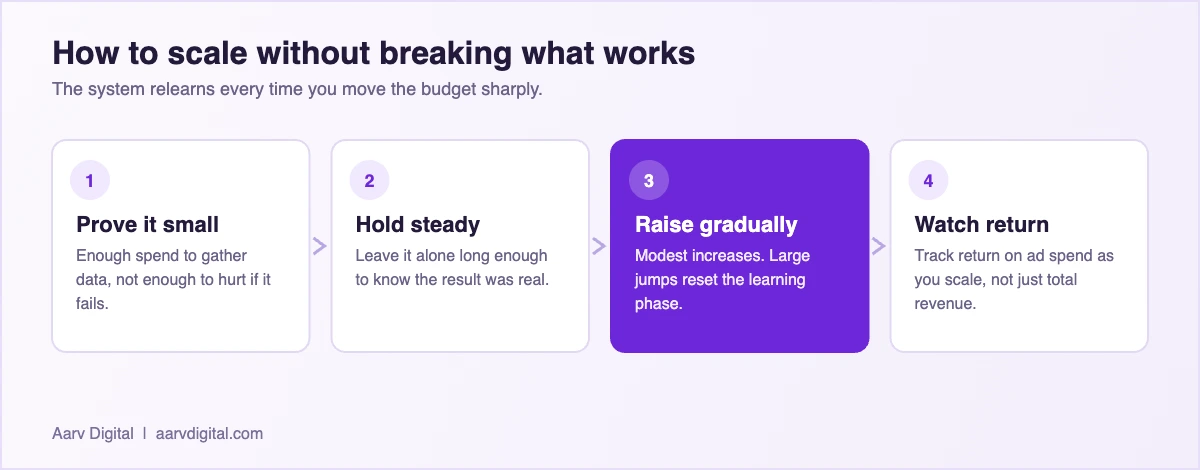
A widely used approach is increasing budget by roughly twenty percent every three to four days, rather than doubling or tripling spend overnight. This gradual pace gives Meta’s delivery algorithm time to find additional inventory and audience without triggering the kind of performance drop that comes from resetting the learning phase with too large a jump.
Horizontal Scaling as an Alternative to Pure Budget Increases
Rather than only increasing budget on an existing ad set, launching an additional ad set with a similar structure and a fresh budget, sometimes called horizontal scaling, can capture more volume without disrupting the performance of an already-optimized campaign. This approach is particularly useful once you notice returns starting to diminish from continuing to scale a single ad set vertically.
Understanding Return on Ad Spend Beyond the Headline Number
Return on ad spend, commonly abbreviated as ROAS, is a useful headline metric, but treating it as the only number that matters can lead to poor decisions.
Blended ROAS Versus Platform-Reported ROAS
Meta’s own reported ROAS inside Ads Manager can differ meaningfully from your blended ROAS calculated from your actual revenue and total ad spend across all channels, partly due to attribution windows and partly due to how conversions are modeled. Checking your blended numbers against your actual business results monthly keeps platform-reported metrics honest and prevents overconfidence in a number that may be inflated by generous attribution settings.
New Customer ROAS Versus Total ROAS
A campaign’s total ROAS can look strong while masking the fact that much of that revenue came from existing customers who would have purchased anyway. Separating new customer acquisition ROAS from total ROAS, where your analytics setup allows it, gives a much clearer picture of whether your ad spend is genuinely growing your customer base or simply taking credit for organic repeat purchases.
| Situation | Common instinct | Better move |
|---|---|---|
| Campaign is working well | Double the budget today | Raise it gradually and let the system keep its learning. |
| Campaign is losing money | Wait and hope it improves | Stop it. Decide the stop-loss before launch, then honour it. |
| Results dipped this week | Rewrite everything | Check whether anything changed first. Weeks vary. |
| You want more volume fast | Add more campaigns | Widen one working campaign. Splitting budget slows learning. |
| Return looks great at low spend | Assume it holds at scale | Expect it to fall as you scale. Plan for that, do not be surprised. |
Common Budget Mistakes That Quietly Drain Startup Cash
A handful of budget-related mistakes show up repeatedly across underperforming startup ad accounts, and most are avoidable once identified clearly.
None of this is unique to paid social. The same discipline of judging spend against customers rather than clicks applies across channels, which is the argument made in the overview of AI marketing trends worth acting on this year.
Spreading a Small Budget Across Too Many Campaigns
Running five campaigns at a fifth of the budget each, rather than one well-funded campaign, usually means none of them generate enough volume to exit the learning phase efficiently. Consolidating budget into fewer, better-funded campaigns consistently outperforms spreading thin across many.
Reacting to Daily Fluctuations
Ad auction dynamics naturally produce day-to-day noise in cost per result, and reacting to every daily uptick by pausing or slashing budget prevents a campaign from ever accumulating enough stable data to be judged fairly. A weekly review cadence, rather than daily, filters out most of this noise.
Ignoring Frequency While Scaling
Increasing budget without monitoring frequency can push the same audience to see your ad far too often, driving up cost per result even as total spend increases. Watching frequency alongside cost per result while scaling helps catch this before it meaningfully erodes performance.
Building a Monthly Budget Review Habit
A sustainable Meta Ads budget strategy is not a one-time setup decision but an ongoing monthly discipline.
What to Review Each Month
Once a month, compare cost per conversion, blended ROAS, and frequency against the prior month, and decide deliberately whether to scale, hold, or pull back budget based on those trends rather than gut feeling. This monthly rhythm, paired with the weekly checks covered earlier, gives a founder enough signal to make confident decisions without falling into the trap of over-managing a campaign day to day. This is the core habit behind any lasting Meta Ads budget strategy.
Reinvesting Profitably Rather Than Maximally
When a campaign is clearly profitable, it is tempting to reinvest every available rupee back into scaling it as fast as possible. A more sustainable approach reinvests enough to grow steadily while keeping some portion of returns as actual profit, since aggressive reinvestment without limit eventually runs into diminishing returns as an audience saturates.
Splitting Budget Across Multiple Platforms
Once Meta Ads are consistently profitable, many startups start weighing whether to split budget with Google Ads or other channels. This decision deserves the same discipline as the initial Meta budget decision rather than an instinctive fifty-fifty split.
Validate One Channel Before Diversifying
A second advertising channel should generally be funded from growth, not by starving a channel that is already working. Pulling budget away from a proven Meta campaign to fund an unproven Google campaign often reduces overall performance during the transition, so incremental new budget toward testing a second channel is usually the safer path.
Attribution Complexity Across Channels
Once spend is split across platforms, a customer’s path to purchase often touches more than one channel, which complicates simple last-click attribution. Reviewing a blended view of total spend against total new revenue each month, rather than trusting each platform’s individually reported numbers, avoids double-counting the same conversion across two dashboards.
Building a Cash-Flow-Aware Budget Calendar
For a startup, ad budget decisions cannot be made in isolation from broader cash flow. A Meta Ads budget strategy that ignores the rest of the business’s cash position risks starving other operational needs during a lean month.
Aligning Ad Spend With Revenue Cycles
Businesses with seasonal or cyclical revenue patterns benefit from planning ad budget increases around periods of stronger cash flow, rather than committing to aggressive scaling right before a historically slower revenue period. This alignment keeps ad spend decisions grounded in the business’s actual financial reality rather than purely campaign performance metrics.
Keeping a Reserve for Re-Testing
Setting aside a small reserve, even five to ten percent of the monthly ad budget, specifically for re-testing creative or audiences after a dip in performance prevents a founder from having to pull entirely from the working budget to diagnose a problem. This reserve becomes especially valuable when a previously reliable campaign suddenly underperforms and needs dedicated testing spend to diagnose without disrupting the main budget.
Frequently Asked Questions
How much should a startup budget for Meta Ads each month?
Enough to generate a meaningful number of weekly conversions per campaign, which varies by industry, but is generally the equivalent of a few thousand rupees per day sustained for at least a few weeks before drawing conclusions about performance.
How quickly can I increase my Meta Ads budget once a campaign is working?
A commonly used pace is roughly twenty percent every three to four days, which gives Meta’s delivery system enough time to adjust without disrupting the performance that made scaling worthwhile in the first place.
What is a realistic ROAS target for a small business?
This varies enormously by industry and margin structure, so the more useful target is your own break-even ROAS calculated from your actual costs and margins, rather than a generic benchmark borrowed from a different type of business.
Should I pause a campaign that had one bad day?
Generally no — normal auction fluctuation produces day-to-day noise, and a single bad day rarely reflects a genuine underlying problem. Reviewing performance weekly rather than daily avoids overreacting to this noise.
Is it better to run one well-funded campaign or several smaller ones?
One well-funded campaign that can generate enough conversion volume to exit the learning phase efficiently generally outperforms several thinly-funded campaigns competing for the same limited budget.
How much of my budget should go toward retargeting?
A modest slice, often referenced around ten percent in common allocation frameworks, is usually enough to capture the meaningfully lower-cost conversions available from warm, already-interested audiences.
Knowing When to Cut Losses on a Campaign
Just as scaling deserves discipline, so does the decision to walk away from a campaign that genuinely is not working, rather than continuing to fund it out of sunk-cost attachment.
Distinguishing a Slow Start From a Failed Concept
A campaign that has not yet accumulated enough spend or conversions to exit the learning phase is simply slow, not failed, and deserves patience through the agreed testing window. A campaign that has cleared a genuine testing period with adequate spend and still shows cost per conversion well above your break-even threshold is a different situation, and continuing to fund it rarely turns into a different outcome without a fundamental change to the offer, creative, or targeting.
Redeploying Budget From an Underperforming Campaign
When a campaign is genuinely cut, redeploying that budget into a better-performing existing campaign or a fresh, differently structured test is usually more productive than letting it sit unspent for a month while deciding on a longer-term plan. Treating budget as an active, continuously-allocated resource, rather than something set once per quarter, keeps a startup’s overall ad spend efficiency higher over time.
Bringing the Full Meta Ads System Together
A disciplined Meta Ads budget strategy only works when it sits on top of the foundation and creative approach covered earlier in this series. Solid account structure and pixel setup give the algorithm clean data to optimize against, strong and varied creative gives it real material to test, and a stable, deliberately-scaled budget gives it the runway to actually find and reward what works. Founders who treat all three as one connected system, rather than three separate problems, consistently build Meta Ads accounts that scale profitably instead of accounts that spike briefly and burn out.
If you are a local business owner or startup founder in Chennai looking to grow faster with smarter marketing, let’s talk. As the Best AI Digital Marketing Freelancer in Chennai, Arvind at Aarv Digital helps small businesses use AI to get more customers, save time, and scale sustainably.
Contact Arvind at Aarv Digital today to start your digital marketing growth journey — visit aarvdigital.com or reach out directly to book a free consultation.

Written by
Arvind Kumar
Founder of Aarv Digital, based in Chennai. Arvind helps local businesses and startup founders use AI to win more customers without adding headcount. New guide every three days.
Keep reading