
Measuring marketing ROI with AI is quickly becoming the difference between small business owners who guess where their budget should go and ones who know. If you have ever run a Google or Instagram ad campaign in Chennai and walked away unsure whether it actually made you money, you are not alone. Most small business owners track likes, followers, and website visits, numbers that feel productive but rarely tell you whether your marketing rupee is actually turning into revenue. This guide breaks down exactly how to measure marketing ROI properly, and how AI tools now do most of the heavy lifting for you.
What Marketing ROI Actually Means for Small Businesses
Marketing ROI, or return on investment, is a simple idea buried under a lot of confusing dashboards. At its core, it answers one question: for every rupee you spend on marketing, how many rupees do you get back in revenue? Everything else, impressions, reach, engagement, is only useful if it eventually connects back to that number. This is the foundation of measuring marketing ROI with AI for any small business.
The Basic ROI Formula
The standard formula is straightforward: ROI = (Revenue from marketing minus Marketing cost) divided by Marketing cost, multiplied by 100 to get a percentage. If you spent ₹20,000 on ads and generated ₹80,000 in sales directly traceable to that campaign, your ROI is 300 percent. The hard part was never the formula, it was always getting accurate numbers to plug into it.
Why Chennai Business Owners Struggle to Track It
Most local businesses run marketing across five or six different channels at once, Instagram, Google Ads, WhatsApp broadcasts, offline flyers, and word of mouth, with no single place tying them together. A customer might see an Instagram ad, ask a friend about it, then walk into the store two weeks later. Traditional tracking loses that entire journey, which is exactly the gap AI-powered tools are now built to close.
On top of that, most small business owners are simply too busy running the business to sit down and manually cross-reference ad spend against sales every week. It is not a lack of interest in the numbers, it is a lack of time, and this is precisely the kind of repetitive analytical work AI tools now handle quietly in the background.
Why AI Changes How You Measure ROI
Measuring marketing ROI with AI has not changed the ROI formula itself, but it has completely changed how much of the data collection and analysis you have to do manually.
From Guesswork to Real Data
Instead of manually exporting spreadsheets from five different ad accounts and trying to line up dates by hand, AI-powered analytics tools pull data automatically from every connected platform and reconcile it in real time. What used to take an agency analyst a full day now takes a few minutes.
Connecting the Dots Across Channels
Modern AI marketing tools use pattern recognition to link a customer’s first touchpoint, say an Instagram ad, to their final purchase, even if that purchase happened through a completely different channel like a phone call or an in-store visit. This is called multi-touch attribution, and it used to be a luxury only large companies could afford. Now it is available in budget-friendly tools any small business can use.
Key Marketing Metrics You Should Be Tracking
Before you can measure ROI with AI, you need to know which numbers actually matter. These four metrics form the foundation.
Cost Per Lead (CPL)
This tells you how much you are spending, on average, to generate one interested enquiry. A falling CPL over time usually means your targeting or messaging is improving.
Customer Acquisition Cost (CAC)
CAC goes one step further than CPL, measuring what it actually costs to turn a lead into a paying customer. This is the number that matters most when deciding whether a channel is genuinely profitable.
Customer Lifetime Value (CLV)
CLV estimates how much revenue a single customer generates over their entire relationship with your business, not just their first purchase. A high CAC can still be worth it if CLV is high enough, which is a nuance most small businesses miss when they only look at short-term numbers.
Return on Ad Spend (ROAS)
ROAS measures revenue generated for every rupee spent specifically on ads, separate from your total marketing ROI. It is the fastest way to compare performance across different ad campaigns side by side.
AI Tools That Make ROI Tracking Easier
Here are accessible AI tools worth exploring for small business ROI tracking:
- Google Analytics 4 — free, AI-powered predictive metrics and cross-channel attribution built in.
- HubSpot — combines CRM data with marketing spend for a clear picture of CAC and CLV.
- Triple Whale — built specifically for e-commerce ROAS and ad spend attribution.
- Improvado — pulls data from multiple ad platforms into one automated dashboard.
- ChatGPT or Claude — useful for quickly analyzing exported spreadsheet data and spotting trends without manual formulas.
How to Set Up AI-Powered ROI Tracking (Step-by-Step)
Here is a practical process any small business in Chennai can follow, even without a dedicated marketing analyst.
Step 1: Define What Counts as a Conversion
Before any tool can measure ROI, you need to be specific about what a “win” looks like, a completed sale, a booked appointment, or a qualified WhatsApp enquiry. Without this definition, even the best AI tool has nothing meaningful to measure.
Step 2: Connect Your Ad Platforms and Website Analytics
Link your Google Ads, Meta Ads, and website analytics accounts into a single dashboard tool. Most modern platforms make this a one-click connection rather than a technical setup process.
Step 3: Let AI Tools Analyze Patterns
Once connected, give the tool a few weeks of data to build a reliable picture. AI models get more accurate the more data they have to work with, so resist the urge to make big decisions in the first few days.
Step 4: Review Weekly, Not Just Monthly
Weekly check-ins let you catch underperforming campaigns early and reallocate budget before you have wasted an entire month’s spend on something that was never going to convert.
Quick Tip
Always track ROI by campaign, not just by overall marketing spend. A single bad-performing campaign can quietly drag down your entire average without you realizing which specific effort is the problem.
Common ROI Measurement Mistakes to Avoid
Even with good tools, a few common habits quietly distort your numbers.
Tracking Vanity Metrics Instead of Revenue
Likes, shares, and follower counts feel good but rarely correlate directly with sales. Always trace metrics back to actual revenue or qualified leads before calling a campaign successful.
Ignoring Offline Conversions
If a customer sees your ad online but calls or walks in to buy, that sale still belongs to your marketing ROI. Many small businesses undercount their real ROI simply because they only track online checkout events.
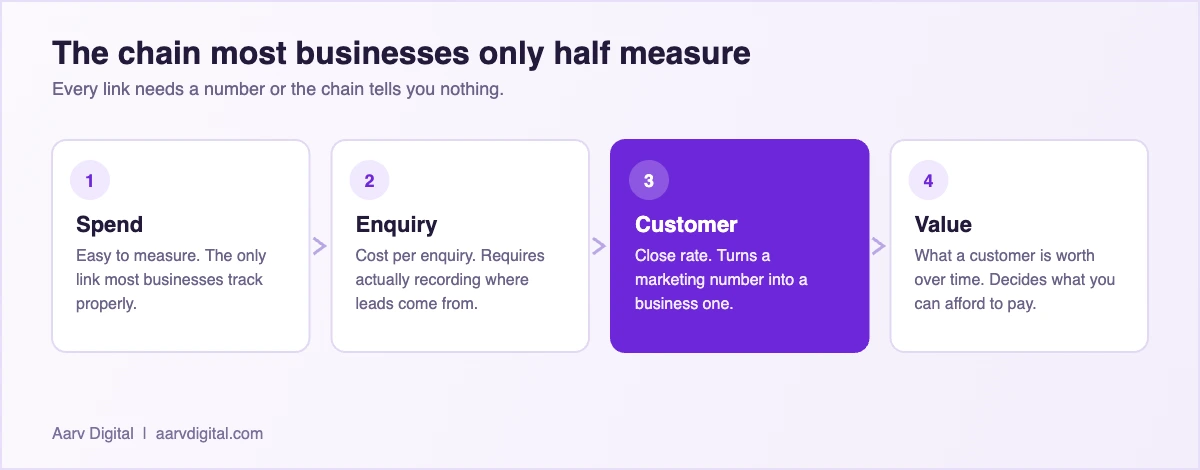
| Metric | Looks impressive | Actually useful |
|---|---|---|
| Impressions | Yes | Rarely. Diagnostic at best. |
| Clicks | Yes | Only as an input. Cheap clicks can mean worse customers. |
| Cost per enquiry | No | Yes. The first number that connects to revenue. |
| Close rate | No | Yes. Tells you whether the problem is marketing or sales. |
| Customer lifetime value | No | Yes. Sets the ceiling on what you can afford to spend. |
| Engagement rate | Yes | Almost never for a local service business. |
A Simple Example: Calculating ROI for a Local Campaign
Say a boutique in Nungambakkam spends ₹15,000 on a two-week Instagram ad campaign. Using an AI-powered analytics tool connected to their WhatsApp Business number and point-of-sale system, they can see that 40 customers who interacted with the ad eventually made a purchase, generating ₹95,000 in total sales. Plugging that into the ROI formula gives (₹95,000 minus ₹15,000) divided by ₹15,000, multiplied by 100, a 533 percent ROI. Without AI-powered tracking connecting the ad clicks to in-store sales, most of that revenue would have been invisible, and the campaign might have looked unprofitable on paper.
Before setting up this kind of tracking, the same boutique had judged the campaign purely on Instagram’s built-in metrics, a modest click-through rate and a handful of comments, and had almost paused it after the first week. Only once the AI-powered dashboard revealed the actual in-store sales it was driving did the real picture become clear, a reminder that surface-level engagement numbers can be dangerously misleading on their own.
How AI Helps You Act on ROI Data, Not Just See It
The real value of AI in ROI measurement is not just reporting numbers, it is turning those numbers into action automatically.
Auto-Optimizing Ad Spend
Many AI-powered ad platforms now shift budget automatically toward the campaigns and audiences generating the best ROI in real time, rather than waiting for you to manually notice and adjust once a week.
Predicting Which Leads Will Convert
Some AI tools can score incoming leads based on patterns from your past customers, telling you which enquiries are most likely to convert so you can prioritize your follow-up time where it matters most.
Free vs Paid AI ROI Tools: Which Should You Start With
One of the most common questions small business owners ask is whether they need to spend money on ROI tracking software right away. The honest answer depends on how many channels you are running and how complex your customer journey already is.
When Free Tools Are Enough
If you are running one or two ad platforms and a website, Google Analytics 4 (explore it here) combined with the native reporting inside Meta Ads Manager will get you surprisingly far. Both now include AI-powered predictive metrics, like predicted conversion likelihood, at no extra cost. For a business just starting to take ROI tracking seriously, this combination is usually the right first step rather than jumping straight into a paid tool.
When It’s Worth Paying
Once you are running four or more channels simultaneously, WhatsApp, Instagram, Google Ads, and offline promotions, manually reconciling free tools becomes a real time cost. This is usually the point where a paid, unified dashboard starts paying for itself, since the hours saved on manual reporting alone often exceed the subscription cost within the first month.
Building an ROI Habit Into Your Marketing Routine
Tools alone do not fix ROI blind spots, the habit of actually looking at the data regularly does. Measuring marketing ROI with AI only works if the habit of checking it sticks.
Set a Recurring 20-Minute Review
Block twenty minutes every Monday morning to review the previous week’s numbers before planning that week’s marketing activity. This single habit catches underperforming campaigns faster than any dashboard sitting unopened in a browser tab.
If you have staff involved in marketing or sales follow-up, share the ROI numbers with them too. When a salesperson knows which leads are coming from the highest-ROI channel, they instinctively prioritize their time better, even without being told to.
Real-World Example for a Chennai Business
A home services business in Velachery was running Facebook ads, Google ads, and WhatsApp broadcasts simultaneously with no idea which one was actually driving bookings. After connecting all three to a single AI-powered dashboard, they discovered that Google ads had a CAC three times higher than WhatsApp broadcasts, despite WhatsApp being the channel they spent the least time on. Reallocating budget away from Google ads and toward WhatsApp automation increased their monthly bookings by nearly 40 percent without spending a single extra rupee. The same unified-dashboard approach also works well alongside AI lead generation strategies already helping other Chennai businesses.
What made this possible was not a bigger marketing budget or a fancier ad creative, it was simply having accurate, unified data instead of three separate, disconnected reports that nobody had time to compare manually. That is the real promise of measuring marketing ROI with AI for a small business, not replacing your judgment, but finally giving that judgment something solid to work with.
AI ROI Tracking vs Hiring a Marketing Agency
A common question from growing businesses is whether AI tools can replace the reporting an agency normally provides, or whether the two work better together.
What AI Tools Do Well
AI-powered dashboards excel at the mechanical parts of ROI tracking, pulling data, spotting patterns, and flagging anomalies faster and more consistently than a human checking spreadsheets once a month. For a small business on a tight budget, this alone can replace a large part of what a junior analyst would otherwise do.
Where a Human Still Matters
What AI tools cannot do is understand the local context behind the numbers, why a Chennai festival week spiked WhatsApp enquiries, or why a competitor’s price change affected your conversion rate. This is where working with someone who understands both the data and the local market, rather than relying purely on automated reports, makes the difference between knowing your numbers and actually acting on them correctly.
What Good ROI Looks Like by Business Type
Benchmarks vary a lot depending on what kind of business you run, and comparing yourself to the wrong industry average is a common source of unnecessary panic.
Retail and E-Commerce
Retail businesses with lower margins typically need higher ROAS, often 400 percent or more, to stay comfortably profitable once product cost and shipping are factored in.
Service Businesses
Service-based businesses like clinics, salons, and consultants usually operate with higher margins per customer, so a lower ROAS around 200 to 300 percent can still be very healthy, especially if customer lifetime value is strong.
Restaurants and Cafes
Restaurants tend to have thin margins but high repeat-visit potential, so ROI should be evaluated over a customer’s first three to six months, not just their first order, since a single ad-driven visit often turns into years of repeat business.
Frequently Asked Questions
Do I need a big budget to start measuring marketing ROI with AI?
No. Many AI-powered analytics tools, including Google Analytics 4, are free to use, and the value comes from consistent tracking rather than expensive software.
How long does it take to see accurate ROI data?
Most tools need at least two to four weeks of consistent data before the numbers become reliable enough to make confident decisions from.
Can AI tools track offline sales too?
Yes, many modern tools integrate with point-of-sale systems and CRM platforms, so in-store or phone-based sales can be linked back to the original marketing source. This usually involves a simple integration setup, sometimes as basic as adding a unique tracking code or asking customers a quick “how did you hear about us” question that gets logged automatically, and it closes one of the biggest blind spots small businesses have when measuring marketing ROI with AI.
What is a good ROI percentage for a small business?
It varies by industry, but most small businesses aim for at least 200 to 400 percent ROI on paid marketing to account for overhead and reinvestment, though even lower ROI can be worthwhile if customer lifetime value is high.
Is Google Analytics enough, or do I need extra tools?
Google Analytics 4 is a strong free starting point, but businesses running ads across multiple platforms usually benefit from a dedicated tool that consolidates everything into one dashboard.
How often should I review my marketing ROI?
Weekly reviews are ideal for catching problems early, with a deeper monthly review to spot longer-term trends and make bigger budget decisions.
What if I don’t have a website, only WhatsApp and Instagram?
You can still measure ROI effectively. Most AI-powered tools now support tracking directly through WhatsApp Business API and Instagram’s native analytics, so a website is helpful but not a strict requirement to start measuring marketing ROI with AI.
Ready to Finally See Where Your Marketing Budget Is Working?
If you are a local business owner or startup founder in Chennai looking to grow faster with smarter marketing, let’s talk. As the Best AI Digital Marketing Freelancer in Chennai, Arvind at Aarv Digital helps small businesses use AI to get more customers, save time, and scale sustainably.
Contact Arvind at Aarv Digital today to start your digital marketing growth journey — visit aarvdigital.com, follow Aarv Digital on LinkedIn, or reach out directly to book a free consultation.

Written by
Arvind Kumar
Founder of Aarv Digital, based in Chennai. Arvind helps local businesses and startup founders use AI to win more customers without adding headcount. New guide every three days.
Keep reading