
AI Search Visibility is the question every business owner will be asking within the next year, and most are not asking it yet. The behaviour has already shifted. People who used to type “best CA in Chennai” into Google and scan ten blue links now ask ChatGPT to recommend one, or read Google’s AI summary and never scroll at all.
That changes what it means to be findable. This guide covers where your business can realistically appear in AI answers, what those systems actually draw on, what you can change on your own site, and, just as importantly, what is outside your control. As the Best AI Digital Marketing Freelancer in Chennai, this is the shift I am asked about most often and the one with the most nonsense written about it.
What Actually Changed
The old model was a list. You searched, you got ten results, you chose. Your job as a business was to be one of those ten. The new model is an answer. Someone asks a question, a system composes a reply, and your business is either mentioned inside that reply or it is invisible.
The difference matters because there is no second page any more. Being the eleventh best answer used to mean occasional traffic. Being the eleventh source an AI considered means nothing at all. The distribution is far more winner-takes-most than traditional search ever was.
But traditional search has not gone away
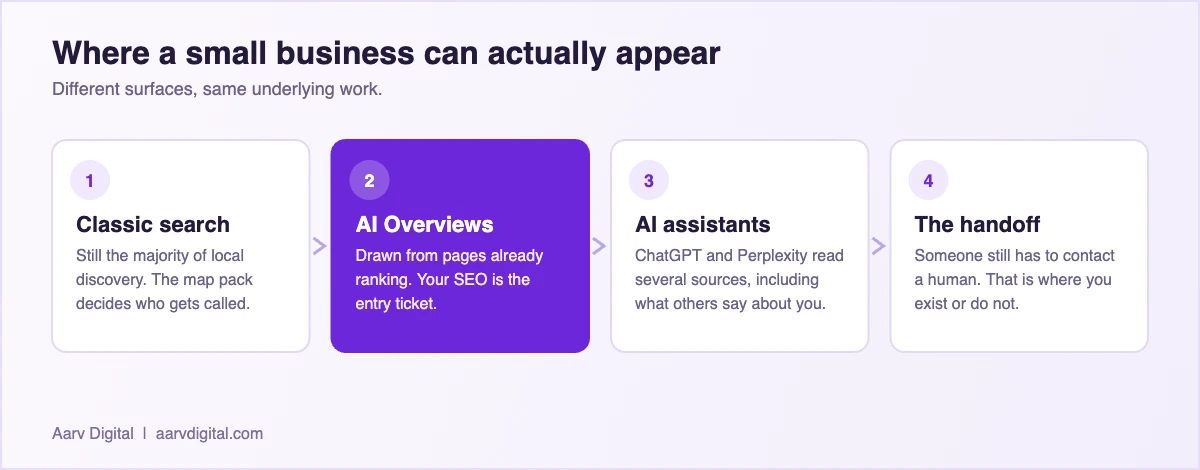
It is worth resisting the panic here. Classic search still drives the overwhelming majority of discovery for local services, and the map pack still decides who gets the call for “plumber near me”. AI search is additive rather than replacing, at least for now. The businesses doing well in AI answers are almost always the ones that were already doing the fundamentals properly.
Where Your Business Can Actually Appear
There are three surfaces worth understanding, and they behave differently.
Google AI Overviews
These are the AI-generated summaries that appear above the traditional results. They draw heavily on pages that already rank well, which means your existing SEO work is the foundation rather than something separate. If you are not in the top handful of results for a query, you are unlikely to be cited in the overview for it.
ChatGPT, Perplexity and similar assistants
These behave more like research tools. They search, read several sources, and synthesise. What gets a business mentioned here is usually being described clearly somewhere the system can read, which often means directories, review sites and other people’s articles rather than your own site alone.
The overlap most people miss
All three surfaces reward the same underlying thing: content that answers a specific question clearly, on a page that is easy to parse, from a source that appears trustworthy. That is not a new discipline. It is the same work, judged by a stricter reader.
What These Systems Draw On
You cannot see inside the models, but the patterns in what gets cited are reasonably consistent and worth building around.
Direct answers placed near the question
Pages that state the answer plainly, immediately after posing the question, get cited far more than pages that build up to it over six paragraphs. If someone asks what something costs, the sentence containing the cost should sit close to the heading containing the word cost. This is unnatural for writers trained to build an argument and it is what these systems reward.
Structure that survives being chopped up
An AI system reads your page in pieces. Clear headings, short paragraphs and sections that make sense on their own all improve the odds that a relevant piece gets pulled out intact. A beautifully argued essay where every paragraph depends on the previous one performs badly, because no single chunk stands alone.
Being described consistently elsewhere
If your business is described one way on your site, differently on your Google Business Profile, and a third way on a directory, you are harder to summarise confidently. Consistency of name, category and service description across the places that mention you does more for AI visibility than most on-site tweaks.
What to Change on Your Own Site
The practical work is narrower than the hype suggests, and most of it is unglamorous.
The changes that actually matter
- Answer the question in the first two sentences under each heading, then elaborate. Not the other way round.
- Use real questions as headings, phrased the way a customer would say them out loud rather than as keyword fragments.
- Keep paragraphs short enough to stand alone. Three to four sentences, each section coherent without the one before it.
- State specifics. Prices, timeframes, areas served, what is included. Vague copy cannot be cited because there is nothing to quote.
- Keep your business details identical everywhere, name, address, phone and category, across your site, your profile and every directory.
Quick Tip: Take your five most common customer questions, the ones you answer on the phone every week, and make each one a heading on the relevant page with a direct answer underneath. That single exercise does more for AI visibility than any technical change, because it creates exactly the question-and-answer pairs these systems are looking for.
One thing not to bother with
You will read advice to add FAQ schema for AI visibility. Be careful with that claim. Google retired FAQ rich results in May 2026, and the markup no longer produces anything visible in Google Search. It is harmless to have and it may help machine readers parse your content, but treating it as an AI visibility tactic overstates a benefit nobody has demonstrated. The plain-language question-and-answer structure is doing the real work, not the markup around it.
The Local Business Angle
For a Chennai service business, the most valuable AI queries are not the broad ones. Nobody wins “best digital marketing agency” in an AI answer. The winnable ones are specific and local: which accountant handles GST for small traders in a particular area, what a service typically costs here, whether a particular kind of business is worth using.
Those answers are built from local signals. A complete and active Google Business Profile, consistent listings, genuine reviews with real detail in them, and pages that actually name the neighbourhoods you serve. This is the same groundwork as local SEO, which is the honest headline of this whole topic: AI visibility for local businesses is mostly local SEO done properly, judged by a new reader.
| What you control | Effort | Effect on AI visibility |
|---|---|---|
| Clear answers placed under question headings | Low | High. This is the single biggest on-site lever. |
| Consistent business details everywhere | Low | High. Inconsistency makes you hard to summarise confidently. |
| Complete Google Business Profile | Low | High for local queries. Feeds the same data as the map pack. |
| Short, self-contained sections | Medium | Medium. Improves the odds a chunk gets lifted intact. |
| FAQ schema markup | Low | None in Google since May 2026. Harmless, but not a tactic. |
| Paying for guaranteed AI placement | Any | None. No such mechanism exists. |
What You Cannot Control
This part is usually left out, and leaving it out is how people get sold expensive nonsense.
You cannot make an AI cite you. There is no submission process, no ranking factor you can adjust, and no dashboard showing your position. Anyone selling guaranteed AI visibility is selling something they cannot deliver. The systems change their behaviour without notice and without documentation.
You also cannot reliably measure it. When someone asks ChatGPT for a recommendation, acts on it, and contacts you, that visit usually arrives with no useful referrer. It looks like direct traffic. This is the most frustrating part of the shift for anyone who likes clean attribution, and it is worth accepting early rather than chasing a measurement that does not exist.
How to Tell If It Is Working
Given that, the honest measurement approach is indirect and slightly old-fashioned.
Ask new enquiries how they found you, and actually record the answer. A rising share of people saying “I asked ChatGPT” or “it came up when I searched” tells you more than any tool currently on the market. Watch for direct traffic rising without a corresponding campaign, which is often AI referrals in disguise. And check periodically by asking the assistants themselves the questions your customers would ask, then seeing whether you appear.
That last one is crude but useful. Run the same five questions monthly, keep a note of whether you are mentioned, and you will have a rough trend line. It is not precise, and for now nothing is. For the broader measurement picture, see the guide on measuring marketing ROI with AI.
Frequently Asked Questions
Is AI search going to kill traditional SEO?
Not in the way the headlines suggest. The mechanics of being findable have changed less than the interface has. Pages that rank well are the pages AI systems cite, so the foundational work is the same. What is changing is the click-through, because a good AI answer means fewer people visit the source.
Should I stop investing in Google Business Profile?
The opposite. Local AI answers lean heavily on the same structured local data that powers the map pack. A complete profile with real reviews and accurate details is one of the few genuinely reliable inputs you control.
Can I submit my site to ChatGPT or Perplexity?
No, and be suspicious of anyone offering to. There is no submission mechanism equivalent to a sitemap. These systems find you the way search engines do, by crawling and by reading what other sources say about you.
Does content length matter for AI visibility?
Less than structure does. A focused thousand words that answer one question clearly will often outperform three thousand rambling ones. What matters is whether a relevant, self-contained chunk can be lifted out and used.
How long until this matters for my business?
For most Chennai service businesses it is a secondary channel today and a meaningful one within a year or two. The sensible posture is to do the work that helps both, which is nearly all of it, rather than restructuring everything around a channel you cannot yet measure.
What is the single highest-value change I can make?
Write plain, specific answers to the questions customers actually ask, and make sure your business is described identically everywhere it appears. That is unglamorous and it is genuinely most of the work.
Should You Write Separate Content for AI?
This question comes up immediately and the answer is almost always no, with one narrow exception worth knowing.
Writing a parallel set of pages aimed at machines is a bad use of a small business’s time. The same qualities that make content citable, clear answers, specific details, honest structure, are the qualities that make it useful to a human reader. Splitting your effort produces two mediocre versions instead of one good one, and search engines have spent twenty years getting better at spotting content written for machines.
The exception is format rather than substance. If you have a genuinely useful page buried in a format nothing can parse, a PDF price list, a long video with no transcript, an infographic carrying all the important numbers as pixels, then creating a plain text version of that same information is worth doing. You are not writing new content for AI, you are making existing content readable.
Beyond that, the honest advice is to write better rather than write differently. Take the page you already have, find the question it answers, put that answer near the top in plain words, and move on to the next page. That is the entire strategy, and it works for readers who are not machines too.
A 60-Minute Audit of Your Own AI Visibility
Rather than guessing, spend an hour finding out where you actually stand. This is the exercise I run for clients before recommending anything, and it usually reveals that the problem is not AI at all.
Step one: ask the questions your customers ask
Write down the ten questions a prospective customer would genuinely type or say. Not keyword phrases, actual questions. “How much does a wedding photographer cost in Chennai.” “Do I need a CA to file GST for a small shop.” Then put each one into Google, ChatGPT and Perplexity, and record whether you appear anywhere in the answer.
Step two: check what the internet says about you
Search your business name in each assistant and read the description it produces. This is revealing and occasionally alarming. If the description is wrong, outdated, or blends you with a similarly named business, that is a data consistency problem you can fix, and fixing it will do more than any content strategy.
Step three: check whether your pages can even be read
Open your most important service page and ask yourself whether any single section, read in isolation, answers a question completely. If every paragraph depends on the one before it, the page will not be cited, however good it is. This is usually the single biggest on-site gap.
What the audit usually reveals
- You are invisible for the broad questions and that is fine, because those were never winnable.
- You are absent from the specific local ones where you genuinely should appear. This is the real gap.
- Your business description varies across three or four places, making you hard to summarise.
- Your pages talk around the answer rather than stating it, which makes them uncitable.
- Your competitors are not doing better, which is the most common finding of all and the reason this is worth doing now.
Where This Is Likely Heading
Predictions in this area age badly, so treat what follows as informed guessing rather than fact. Three things look reasonably safe to assume.
First, the click-through rate from search to websites will keep falling, because good answers reduce the need to visit. That makes the answer itself the product, and being cited inside it more valuable than ranking beneath it. Businesses that treat their website purely as a traffic destination will feel this most.
Second, local and transactional queries will resist this longer than informational ones. Someone asking how to fix a leak may never click. Someone who needs a plumber tonight still has to contact a human, and that handoff is where your business either exists or does not. For local service businesses this is genuinely reassuring.
Third, measurement will stay poor for a while. Expect attribution to get murkier before it gets better, and expect a wave of tools claiming to measure AI visibility more precisely than is currently possible. Judge those claims sceptically and keep asking your customers how they found you, which remains the most reliable data source you have.
None of this changes what to do next week. Answer real questions clearly, keep your details consistent, and keep the fundamentals in good order. That work pays off whichever way the interface goes.
Do the Boring Work First
AI search rewards clarity, specificity and consistency. Those are the same things good customers reward. If you are choosing between chasing an AI tactic and simply answering your customers’ real questions properly on your own site, answer the questions. It works for both readers, and only one of them is guaranteed to exist next year.
If you are a local business owner or startup founder in Chennai looking to grow faster with smarter marketing, let’s talk. As the Best AI Digital Marketing Freelancer in Chennai, Arvind at Aarv Digital helps small businesses use AI to get more customers, save time, and scale sustainably.
Contact Arvind at Aarv Digital today to start your digital marketing growth journey, visit aarvdigital.com or reach out directly to book a free consultation.

Written by
Arvind Kumar
Founder of Aarv Digital, based in Chennai. Arvind helps local businesses and startup founders use AI to win more customers without adding headcount. New guide every three days.
Keep reading