
Once the foundation is in place, the next question every startup founder asks is what to actually put in front of people. Meta Ads creative ideas matter more than almost any other variable in a campaign’s performance, more than targeting, more than bidding strategy, more than budget size.
Meta’s own delivery systems are built to test creative variety and reward whatever resonates, which means a founder who understands how to brief, produce, and structure ad creative has a real advantage over one who simply uploads a single polished image and hopes for the best. This guide covers the Meta Ads creative ideas that actually work on Facebook and Instagram in 2026, from campaign concepts to the practical mechanics of producing enough variety to give Meta’s algorithm something to work with.
Why Creative Is the Highest-Leverage Variable in Meta Ads
Ad platforms have gotten remarkably good at finding the right audience automatically. Meta’s Advantage+ targeting, broad audience delivery, and machine-learning bidding have taken much of the targeting guesswork out of running ads. What is left, and what increasingly separates winning campaigns from mediocre ones, is the creative itself — the image, video, and copy that actually stops someone mid-scroll.
This shift matters enormously for a resource-constrained startup. It means the biggest return on your limited time and budget often comes from producing more creative variety, not from obsessing over audience targeting settings that Meta’s algorithm is already optimizing on its own. Pairing strong Meta Ads creative ideas with the account structure covered in our Meta Ads for startups foundation guide gives a new campaign the best possible starting point.
Volume and Variety Beat a Single Polished Ad
A campaign running eight to twelve genuinely different creative concepts, the core of any solid Meta Ads creative ideas strategy, consistently outperforms a campaign running one or two highly polished ads, because Meta’s delivery system needs real variety to identify what resonates with different audience segments. A single expensive, perfectly art-directed ad often loses to a handful of rougher, more varied concepts simply because there is more for the algorithm to learn from.
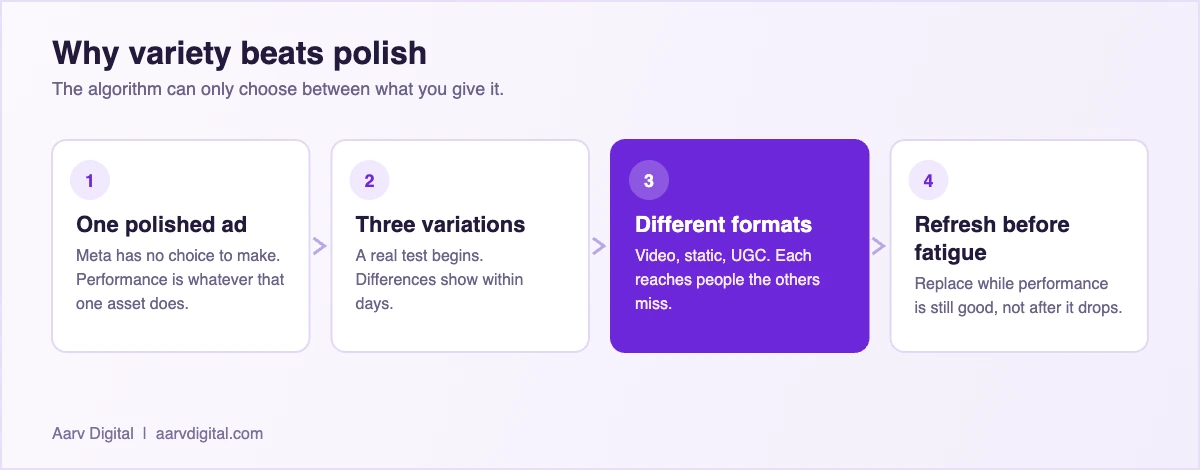
Meta Ads Creative Ideas That Work for Startups in 2026
Rather than starting from a blank page, it helps to work from a set of proven campaign concepts and adapt them to your specific product or service.
Creative is only half of it. The formats that tend to work hardest on Meta are the same short-form ones covered in the guide to AI video and Reels marketing, which is where most of this production actually happens.
The Founder Story Campaign
A short, unpolished video of the founder speaking directly to camera about why they built the product consistently performs well, especially for early-stage startups with no brand recognition yet. This format works because it feels authentic rather than produced, and audiences have grown skeptical of overly polished corporate ad content.
The Problem-Agitation-Solution Campaign
This classic direct-response structure opens by naming a specific, relatable problem your audience faces, agitates it briefly by describing the cost of not solving it, then introduces your product as the solution. It works particularly well as a short vertical video or a text-heavy static image and remains one of the most reliable creative frameworks across industries.
The Demo or Before-and-After Campaign
Showing your product actually being used, or showing a clear before-and-after result, removes the guesswork for a potential customer about what they are actually buying. For software products, this might be a simple screen recording; for physical products or services, a genuine before-and-after visual is often the single highest-converting asset in a campaign.
The Social Proof Campaign
A short clip of a real customer describing their result, or a carousel of genuine testimonials and star ratings, builds trust quickly, especially for a startup with limited brand history. This works best when the testimonial is specific — a number, a timeframe, a concrete outcome — rather than a vague endorsement.
The Educational or Myth-Busting Campaign
Content that teaches the audience something useful, or corrects a common misconception related to your product category, tends to earn strong engagement because it delivers value before ever asking for a purchase. This format also works well for building a retargeting audience, since people who watch an educational video have shown genuine interest even if they did not convert immediately.
A Practical Creative Brief Checklist for Startups
Before producing any new ad creative, working through this checklist keeps the output aligned with what actually performs on Meta:
- Does the first 3 seconds work with the sound off? Most people scroll with audio muted.
- Is the hook — the visual or line that stops the scroll — in the very first frame, not buried after an intro?
- Is the format vertical (9:16) and native-feeling, rather than a repurposed horizontal video with black bars?
- Does the ad clearly show the product or the specific outcome, rather than just abstract brand messaging?
- Is there a single, clear call to action, rather than multiple competing asks?
Quick Tip
Before shooting anything new, look through your camera roll and existing customer messages for raw, unpolished footage or screenshots. A genuine customer WhatsApp message praising your product, screen-recorded and read aloud, frequently outperforms a scripted, professionally shot testimonial.
Choosing the Right Format for Each Placement
Meta ads run across Facebook Feed, Instagram Feed, Stories, Reels, Marketplace, and the Audience Network, and roughly 90% of ad inventory today is vertical. Producing at least three distinct asset shapes — a 1:1 or 4:5 crop for Feed, and a 9:16 vertical for Stories and Reels — ensures your creative actually fits the space it is shown in rather than appearing as a small, awkwardly cropped video inside a full-screen format.
Why Native-Feeling Content Outperforms Polished Production
User-generated-style content, even when produced by the brand itself, tends to earn significantly higher click-through rates for cold prospecting audiences than heavily produced brand videos, because it blends into the organic feed rather than announcing itself as an advertisement. Save the more polished, brand-forward creative for retargeting audiences who already know and trust you — cold audiences respond better to content that feels like a recommendation from a peer rather than a corporate pitch.
Writing Ad Copy That Complements Strong Creative
Even the best visual needs copy that reinforces rather than repeats what is already on screen. Short, direct primary text that adds new information — a price, a guarantee, a specific benefit — performs better than copy that simply describes what is already visible in the image or video.
Producing enough variety without burning out is a scheduling problem more than a creative one. The AI content calendar approach is what makes a steady supply of creative sustainable for a small team.
Headline Testing at Scale
Rather than agonizing over a single headline, generate eight to ten variations built around different angles — one emphasizing price, one emphasizing speed, one emphasizing a guarantee, one emphasizing social proof — and let Meta’s own delivery system determine which resonates with which audience segment. This approach consistently produces better results than a single, carefully-workshopped headline chosen by committee.
Building a Sustainable Creative Production System
The biggest obstacle most startups face is not knowing what creative concepts to try, but sustaining creative output over time. Ad fatigue is real, as covered in Meta Business Help Center, — Meta recommends refreshing two to three new creative assets weekly to prevent the same audience from seeing the same ad so often that performance declines.
Batch Production Over One-Off Shoots
Rather than producing one ad at a time as campaigns need refreshing, set aside a single afternoon each month to batch-produce a month’s worth of raw footage, photos, and customer testimonials. This single shift in workflow — from reactive, one-off production to planned batch production — is often what separates startups that maintain consistent ad performance from those whose campaigns decay every few weeks as creative fatigue sets in.
Repurposing Organic Content Into Paid Creative
Your best-performing organic social posts are often an underused source of paid ad creative. A Reel or post that already earned strong organic engagement has effectively been pre-tested by real audience behavior, making it a safer bet to put media spend behind than an entirely new, unproven concept.
| Creative type | Effort to produce | Best at |
|---|---|---|
| Founder to camera | Low. A phone and daylight. | Trust and explanation. Works unreasonably well for services. |
| Customer testimonial | Medium. Requires asking. | Overcoming doubt. The most persuasive asset you can own. |
| Product or work photo | Low | Proof that you actually do the thing. Beats stock every time. |
| Text on plain background | Very low | Testing a message cheaply before investing in production. |
| Polished studio video | High | Brand, rarely direct response. Often the worst return per rupee. |
Testing and Iterating on Campaign Ideas
Running a new creative concept is only half the process — reviewing performance and iterating deliberately is what compounds results over time.
Creative testing is one of several places where the tooling has moved faster than most small businesses have. The shortlist of AI tools for local business covers what is genuinely worth paying for at this scale.
Reading Creative Performance Signals Correctly
A high click-through rate paired with a low conversion rate usually signals a mismatch between what the ad promises and what the destination page delivers, not a failure of the creative itself. A low click-through rate, on the other hand, almost always points back to the hook or thumbnail failing to earn attention in the first place, and is best solved by testing a different opening few seconds rather than tweaking the rest of the ad.
Knowing When to Kill an Underperforming Concept
Give a new creative concept a genuine testing window — typically 3 to 5 days with adequate spend — before deciding whether it works. Killing a concept too early, before it has accumulated enough impressions and clicks to be statistically meaningful, means you never actually learn whether the underlying idea was sound. This patience is a core part of any disciplined Meta Ads creative ideas process.
Common Creative Mistakes That Quietly Waste Ad Spend
Beyond having too few creative variations, a handful of specific creative mistakes show up repeatedly in underperforming startup campaigns, and most are simple to fix once identified.
Burying the Offer Too Deep
Many ads spend the first ten to fifteen seconds building context or brand story before ever mentioning what is actually being offered, by which point most viewers have already scrolled past. Leading with the offer or the core benefit in the first few seconds, then supporting it with context afterward, consistently outperforms a slow narrative build-up in a cold-audience ad.
Using Desktop-Shot Horizontal Video
A horizontal video shot for a website or YouTube, then dropped into a Meta placement with black bars on either side, immediately signals repurposed content rather than something made for the platform, and this visual cue alone measurably reduces engagement. Shooting vertically from the start, even for content that will also live elsewhere, avoids this problem entirely.
Overloading a Single Ad With Multiple Messages
Trying to communicate a product’s price, quality, speed, and guarantee all within one fifteen-second ad usually means none of those messages land clearly. A stronger approach tests each angle as its own separate ad, then lets performance data reveal which single message resonates most with your specific audience.
Frequently Asked Questions
How many ad creatives should a startup run at once?
Somewhere between three and five genuinely different creatives per ad set is a reasonable starting point, scaling toward eight to twelve variations as your account matures and Meta’s Advantage+ systems have more assets to test against each other.
Do I need professional video production for Meta Ads to work?
No — in many cases, raw, unpolished, phone-shot footage that feels native to the platform outperforms professionally produced video, especially for cold prospecting audiences seeing your brand for the first time.
How often should I refresh my ad creative?
Introducing two to three new creative assets weekly is a reasonable cadence to prevent ad fatigue, though the exact frequency depends on your audience size and how quickly frequency climbs in your account.
What is the single most important part of a Meta video ad?
The first three seconds. Since most people scroll with sound off and make a stay-or-scroll decision almost instantly, the opening visual and hook determine whether the rest of the ad ever gets seen.
Should ad copy repeat what is shown in the creative?
No — the strongest-performing ad copy adds new information not already visible in the image or video, such as a specific price, guarantee, or timeframe, rather than simply describing what the viewer can already see.
How long should I test a new creative concept before judging it?
Generally 3 to 5 days with adequate spend to accumulate enough impressions and clicks for the results to be statistically meaningful, rather than judging performance after just a few hours or a single day.
Working With Characters and Creators Instead of Just Products
Some of the strongest-performing Meta Ads in 2026 do not feature the product at all in the opening frames — they feature a person the viewer can relate to, reacting to a problem the product eventually solves. This is part of why partnering with small, niche content creators, even ones with modest followings, often produces stronger ad performance per rupee spent than an ad built entirely around brand-owned footage.
Micro-Influencer Content as a Creative Source
A creator with ten thousand genuinely engaged followers in a specific niche often produces content that feels more native and trustworthy in an ad placement than content from a much larger, more generic creator. For a startup on a limited budget, sending free product to a handful of relevant micro-creators in exchange for raw content usage rights is frequently more cost-effective than commissioning a traditional video shoot.
Seasonal and Trend-Responsive Campaign Ideas
Beyond evergreen campaign structures, tying creative concepts to seasonal moments, festivals, or relevant cultural trends in your market gives your ads a timely, relevant feel that generic always-on creative lacks. A Chennai-based startup, for example, can build short campaign bursts around Pongal, the monsoon season, or the back-to-school period, adapting the same underlying offer to feel specific to that moment.
Balancing Evergreen and Trend-Driven Creative
A healthy creative calendar mixes a small number of always-on, evergreen ads that run continuously with a rotating set of timely, trend-responsive creative refreshed every few weeks. Relying entirely on trend-driven content risks gaps in your always-on prospecting; relying entirely on evergreen content risks feeling stale next to competitors running timely, relevant campaigns.
Spotting Creative Fatigue Before It Hurts Performance
Every ad, no matter how strong, eventually wears out as the same audience sees it repeatedly. Recognizing the early signs of creative fatigue lets you refresh a concept before performance visibly declines, rather than reacting after cost per result has already climbed.
Frequency as an Early Warning Signal
When frequency — the average number of times a person has seen your ad — climbs above roughly three within a short window while click-through rate simultaneously declines, this combination is a reliable early signal of creative fatigue setting in. Catching this pattern early and rotating in a fresh creative concept preserves performance that would otherwise erode gradually over the following days.
Turning Creative Strategy Into Consistent Results
Strong Meta Ads creative ideas are not about finding one perfect ad — they are about building a repeatable system for producing enough genuine variety that Meta’s own delivery algorithm has real material to test and optimize against. Founders who treat creative production as an ongoing, batched process rather than a one-time task consistently outperform those chasing a single winning ad. In the next and final post in this series, we cover how to translate strong creative into a disciplined budget and ad spend strategy that scales profitably.
If you are a local business owner or startup founder in Chennai looking to grow faster with smarter marketing, let’s talk. As the Best AI Digital Marketing Freelancer in Chennai, Arvind at Aarv Digital helps small businesses use AI to get more customers, save time, and scale sustainably.
Contact Arvind at Aarv Digital today to start your digital marketing growth journey — visit aarvdigital.com or reach out directly to book a free consultation.

Written by
Arvind Kumar
Founder of Aarv Digital, based in Chennai. Arvind helps local businesses and startup founders use AI to win more customers without adding headcount. New guide every three days.
Keep reading